CHANGZHOU, China, Sept. 24, 2026 /PRNewswire/ -- TrinaTracker, a global provider of smart tracking systems and a wholly owned subsidiary of Trina Solar Co., Ltd. (SHA: 688599), has launched two self-developed robotic products: BUILDEX PV Module Installation Robot and AURORA PV Cleaning Robot, to expand its Smart PV Ecosystem.
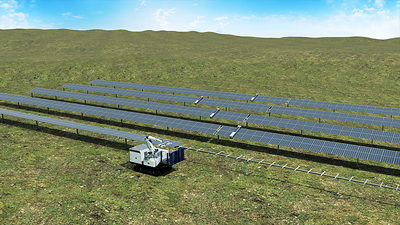
Since the beginning of the year, TrinaTracker has transformed from a tracking system equipment supplier into a Smart PV and Robotics Solution Provider. By integrating high-reliability trackers, AI algorithms, installation and cleaning robots, as well as engineering and intelligent operations services, the company delivers a full lifecycle solution for PV power plants by optimizing plant design, improving construction and O&M quality, and reducing operational costs.
BUILDEX PV Module Installation Robot: Breaking Construction Bottlenecks
Large-scale PV projects have traditionally relied heavily on manual module installation, resulting in heavy labor input, long construction cycles, high costs, inconsistent installation precision and safety risks, hindering barriers to standardized rollout. BUILDEX reshapes PV construction through automated, standardized and intelligent workflows.
Powered by high-precision AI vision positioning and integrated precision mechanical control systems, BUILDEX autonomously completes module picking, transportation, alignment and placement. It adapts to complex terrain and diverse tracker layouts, reducing labor intensity and safety risks while improving installation accuracy and delivery speed for large-scale solar bases.
AURORA PV Cleaning Robot: Safeguarding Energy Yield and Enabling Refined Smart O&M
PV plants operate under harsh outdoor conditions. Dust and stains on module surfaces block sunlight and reduce power generation, undermining long-term plant revenue. Conventional manual cleaning is constrained by terrain, weather, labor and safety risks, making it unsuitable for large-scale refined O&M. AURORA delivers unmanned, non-damaging, regular and intelligent cleaning to maintain module cleanliness, boost power output, lower long-term O&M costs and unlock asset value.
Combining AI & Robotics: Redefining PV Asset Value
TrinaTracker's investment in AI and robotics is not merely hardware iteration, but a strategic upgrade of its full-stack "Tracker+" smart energy ecosystem. AI serves as the digital brain for robotic hardware, connecting construction automation and routine O&M. Physical PV assets are coupled with digital twins to help plant owners lower LCOE and maximize asset value.
Global operational data from TrinaTracker's worldwide portfolio fuels continuous AI algorithm optimization, equipping its robots with strong adaptability for complex terrain, extreme weather and dynamic structural conditions. Robot data integrates with Trina's digital platform to create a new model of fully automated, intelligent PV plant management.
The rollout of AI robotic products marks a key milestone in TrinaTracker's transformation from "equipment leadership" to "digital & intelligent leadership". Moving forward, TrinaTracker will continue advancing PV intelligence, enriching its robot portfolio and deepening AI integration across PV scenarios to refine the "Tracker+" ecosystem. The company will deliver all-in-one smart PV solutions to accelerate global solar development and support clean energy transition and carbon neutrality goals.
 View original content to download multimedia:https://www.prnewswire.co.uk/news-releases/trinatracker-launches-two-robots-to-expand-its-smart-pv-ecosystem-302889017.html

Die Exzellenzstrategie von Bund und Ländern stellt die Weichen für die nächste Förderperiode – und verschiebt die Gewichte im deutschen Wissenschaftssystem. Zu den bundesweit fünf neuen Exzellenzstandorten gehören die Technische Universität Darmstadt, die Goethe-Universität Frankfurt und die Johannes Gutenberg-Universität Mainz, die sich als Allianz der Rhein-Main-Universitäten (RMU) durchgesetzt haben. Ebenfalls erfolgreich waren in Nordrhein-Westfalen die Universität zu Köln sowie der Verbund Ruhr Innovation Lab aus TU Dortmund und Ruhr-Universität Bochum.
Für Hessen ist die Entscheidung ein Durchbruch: Erstmals tragen Universitäten des Landes ab 2027 den Titel „Exzellenzuniversität“. Die RMU-Allianz erhält nach Angaben des hessischen Wissenschaftsministeriums über sieben Jahre eine Förderung von insgesamt bis zu 155 Millionen Euro, finanziert zu 75 Prozent vom Bund. Wissenschaftsminister Timon Gremmels spricht von den ersten Exzellenzunis in Hessen und zugleich vom ersten länderübergreifenden Verbund in der Exzellenzstrategie. Ministerpräsident Boris Rhein bezeichnet den Titel als Meilenstein für die Forschungslandschaft des Landes. Ein mittelhessischer Verbund aus den Universitäten Gießen und Marburg blieb im Wettbewerb dagegen ohne Erfolg.
Auch Nordrhein-Westfalen stärkt seine Rolle als Hochburg der Spitzenforschung. Neben der Universität Köln, die den begehrten Status nach einer früheren Förderphase von 2012 bis 2019 zurückerhält, steigt der Verbund aus TU Dortmund und Ruhr-Uni Bochum als Ruhr Innovation Lab in den Kreis der Exzellenzuniversitäten auf. Nach Angaben des Düsseldorfer Wissenschaftsministeriums baut das Land damit seine Führungsposition aus. Die Universität Bonn und die RWTH Aachen hatten ihren Exzellenzstatus bereits im Frühjahr verteidigt, sodass NRW künftig mit vier Standorten vertreten ist. Ministerpräsident Hendrik Wüst wertet dies insbesondere als Signal für die internationale Sichtbarkeit des Ruhrgebiets als Wissenschafts- und Innovationsstandort.
In Bonn gaben Bundesforschungsministerin Dorothee Bär und der niedersächsische Wissenschaftsminister Falko Mohrs als Vize-Vorsitzender der Gemeinsamen Wissenschaftskonferenz (GWK) neben den Standorten in Hessen und NRW auch die Universitäten Freiburg und Jena als neue Exzellenzunis bekannt. Für Einzeluniversitäten sieht das Programm Fördermittel von bis zu 15 Millionen Euro pro Jahr vor, bei Verbünden wie der Rhein-Main-Allianz oder dem Ruhr Innovation Lab können es bis zu 28 Millionen Euro sein. Damit wächst die Riege der Exzellenzuniversitäten, deren bisher neun Standorte – darunter Aachen, Bonn, Dresden, Hamburg, Heidelberg, Karlsruhe, München, Tübingen sowie die Berlin University Alliance – ihre Förderung bereits im Frühjahr um weitere sieben Jahre verlängert hatten. Der Titel ist jeweils an regelmäßige Überprüfungen der Fördervoraussetzungen geknüpft.




