New 13.8MVA/25MWh integrated solution brings together advanced DC and AC technologies to simplify deployment and enhance performance for utility-scale storage projects
MUNICH, June 24, 2026 /PRNewswire/ -- Trina Storage, a global energy storage solutions provider, today unveiled its next-generation integrated DC+AC solution – Elementa + Electra 13.8MVA/25MWh – at Intersolar Europe 2026. Combining the company's latest Elementa storage system with its upgraded 13.8MVA Electra AC platform, the solution is designed to address the evolving demands of large-scale renewable energy and grid applications.
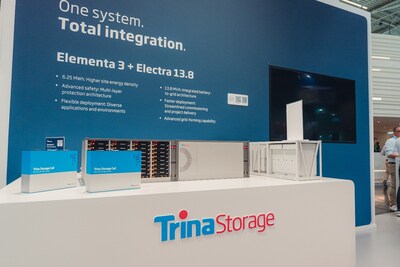
As the energy storage industry enters a new phase of scale and maturity, project developers are increasingly prioritizing solutions that simplify deployment while maximizing long-term value. Reflecting this trend, Trina Storage's presence at Intersolar Europe 2026 focuses on technologies designed to improve efficiency, reliability, and scalability across the energy storage value chain.
Taking center stage at the exhibition, Elementa + Electra delivers up to 25MWh of storage capacity and 13.8MVA of AC output through an integrated DC+AC architecture. By combining battery storage and AC technologies within a single solution, it helps reduce system complexity, streamline project execution, and support efficient deployment at scale.
Designed to maximize project returns, Elementa + Electra features a compact, highly integrated architecture that improves power density and site utilization. An integrated auxiliary transformer further reduces footprint requirements, while advanced balancing and power conversion technologies enhance energy throughput and overall system efficiency.
Built for increasingly demanding grid environments, the solution combines a three-tier liquid cooling architecture with fast-response power conversion capabilities. Cell-level temperature control maintains a temperature difference of less than 2.5°C across cells, while the Electra platform supports a 10ms full-power response time and flexible active and reactive power control. Grid-forming and black-start capabilities further strengthen the system's ability to support evolving grid requirements.
Safety remains a core element of the solution's design. Advanced thermal protection technologies, multi-layer electrical safeguards, and coordinated DC-AC safety architecture work together to support safe and stable operation across a wide range of applications.
Beyond performance and safety, Elementa + Electra is engineered to simplify deployment and reduce total project costs. Both DC and AC systems support containerized transportation, reducing logistics complexity and installation requirements. Extensive factory-level testing and validation through Trina Storage's system integration validation platform help reduce on-site commissioning time by up to 50%, accelerating project delivery and minimizing execution risk.
Industry recognition has further reinforced Trina Storage's innovation efforts. This year, Elementa 3 was selected as a finalist in the The smarter E AWARD 2026 Energy Storage category, recognizing its advanced system design and contribution to the continued advancement of utility-scale energy storage technologies.
"The launch of Elementa + Electra reflects our continued commitment to advancing integrated energy storage solutions for the utility-scale market," said Shawn Deng, Head of global product and system integration at Trina Storage. "Customers increasingly expect storage systems to deliver not only higher performance, but also greater reliability, simplified deployment, and stronger project economics. This new solution has been developed to address those priorities while supporting the next stage of global energy storage growth."
Alongside the launch of Elementa + Electra 13.8MVA/25MWh, Trina Storage is also showcasing its latest 587Ah battery cell technology and highlighting recent project developments across key global markets.
Throughout the exhibition, Trina Storage's booth has attracted strong engagement from customers, partners, and industry stakeholders worldwide. Discussions have focused on emerging market opportunities and the growing role of energy storage in supporting the next phase of renewable energy growth, reflecting the accelerating momentum of the global storage market.
Photo - https://mma.prnewswire.com/media/2999338/image1.jpg
 View original content:https://www.prnewswire.co.uk/news-releases/trina-storage-unveils-next-generation-elementa--electra-integrated-dcac-solution-at-intersolar-europe-2026-302809034.html

Die Zukunft des deutsch-französischen Panzerprojekts MGCS gerät zunehmend ins Wanken. Armin Papperger, Vorstandschef des Düsseldorfer Rüstungskonzerns Rheinmetall, schließt einen Rückzug Frankreichs aus dem Vorhaben nicht mehr aus. In einem Interview mit der „Welt am Sonntag“ sprach er von einem „Gefahrenszenario“, betonte allerdings, dass bislang keine endgültigen Entscheidungen gefallen seien. Die Diskussionen kommen zu einem Zeitpunkt, an dem mit dem Ende des Kampfflugzeugprojekts FCAS (Scaf) bereits ein anderes zentral geplantes Vorzeigeprojekt der Verteidigungskooperation zwischen Berlin und Paris gescheitert ist.
Nach Informationen Pappergers plant Frankreich, das Budget für das „Main Ground Combat System“ (MGCS) drastisch zu kürzen. Im Gespräch ist demnach ein Ansatz von weniger als der Hälfte der ursprünglichen Planungen. Zwar unterstrich der Rheinmetall-Chef, dass es „null Entscheidungen über das finale Budget“ gebe, doch ein reduzierter Finanzrahmen hätte nach seiner Einschätzung unweigerlich die Streichung von Leistungsumfängen und weitere Verzögerungen zur Folge. „Wenn man weniger Geld zur Verfügung hat, wird man nicht schneller, und wir sind jetzt schon sehr langsam“, sagte er. Bereits jetzt liegt das Programm, das seit rund einem Jahrzehnt läuft, weit hinter den ambitionierten politischen Ankündigungen zurück.
Das MGCS-Projekt wurde auf Initiative der Regierungen Frankreichs und Deutschlands gestartet, um ein gemeinsames, plattformübergreifendes Bodenkampfsystem zu entwickeln, das ab etwa 2040 die Kampfpanzer Leopard 2 und Leclerc ersetzen soll. Beteiligt sind neben Rheinmetall der französische Technologiekonzern Thales sowie KNDS – ein Zusammenschluss des deutschen Herstellers Krauss-Maffei Wegmann und des staatlichen französischen Rüstungsunternehmens Nexter. Trotz der politischen Bedeutung des Vorhabens sind die finanziellen Mittel bislang überschaubar: Die vier Partnerunternehmen haben in rund zehn Jahren zusammen lediglich 25 Millionen Euro erhalten, was Papperger als „offensichtlich sehr wenig Geld“ bezeichnete.
Parallel zum schleppend verlaufenden MGCS treiben Rheinmetall und KNDS Deutschland auf deutscher Seite bereits eine Zwischenlösung voran. Der in der Militärfachpresse inoffiziell „Leopard 3“ genannte neue Kampfpanzer soll nach aktueller Planung Anfang der 2030er Jahre in Dienst gestellt werden und damit die Lücke überbrücken, bis ein mögliches MGCS-System verfügbar wäre. Für MGCS selbst wird die Einsatzreife derzeit erst in den 2040er Jahren erwartet – ein Zeithorizont, den Papperger als „eine Wahnsinnszeit“ bezeichnete. Vor diesem Hintergrund stellte er die grundsätzliche Realisierung des Projekts offen in Frage: „Ich kann heute nicht sagen, ob es überhaupt ein MGCS geben wird.“ Die jüngsten Budgetüberlegungen in Paris verstärken diese Unsicherheit und nähren Zweifel daran, ob Europa den angestrebten gemeinsamen Panzer der Zukunft tatsächlich auf die Spur bringen kann.