Recognition highlights Trina Storage's Cell-to-AC integration capabilities, technology innovation, and growing global delivery footprint.
MUNICH, July 2, 2026 /PRNewswire/ -- Trina Storage, a global energy storage solutions provider, has been ranked among the world's Top 5 battery energy storage system (BESS) integrators and recognized as a Grade A BESS Integrator in Wood Mackenzie's latest Global Battery Energy Storage System Integrator Comprehensive Ranking 2026, reinforcing its position as a leading global provider of utility-scale energy storage solutions.
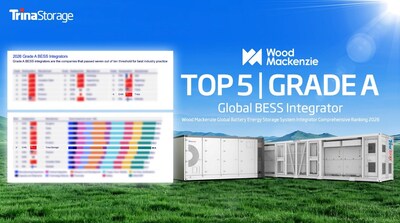
Published annually by leading energy research and consultancy firm Wood Mackenzie, the report evaluates BESS integrators across a broad range of criteria, including manufacturing experience, vertical integration, R&D capabilities, supply chain stability, technology maturity, financial strength, safety performance, and ESG commitments. In addition to ranking integrators globally, Wood Mackenzie awards Grade A status to companies that meet its highest qualification thresholds across key operational, technical, and financial indicators. The assessment is widely regarded as one of the industry's most authoritative benchmarks for evaluating the competitiveness and bankability of energy storage system providers.
"This recognition reflects the strength of our technology, execution capabilities, and commitment to delivering reliable storage solutions at scale," said Mr. Yang Bao, President of Energy Storage Division at Trinasolar. "As energy storage deployment accelerates globally, customers increasingly value partners that can combine innovation, quality, and delivery certainty. We are proud to see these efforts reflected in both our Top 5 ranking and Grade A classification by Wood Mackenzie."
A key factor behind Trina Storage's ranking is its expanding Cell-to-AC integration capability and growing global delivery track record. By integrating battery technology, AC-side conversion, and system integration within a unified solution architecture, Trina Storage enables greater control over system performance, project execution, and lifecycle value. This approach supports the increasing demand for reliable, bankable, and scalable energy storage deployments across global markets.
Continued investment in R&D further strengthens Trina Storage's technology and delivery capabilities. The company's advanced AC validation platform enables comprehensive verification of storage systems across real-world operating scenarios, including system integration, grid interaction, environmental testing, and EMS validation prior to deployment. Combined with robust supply chain management, internationally recognized certifications across major markets, strong ESG commitments, and sustained R&D investment, these capabilities contribute to Trina Storage's competitiveness across global energy storage markets.
The company's integrated delivery capabilities are exemplified by its recently announced Gamma project, where Trina Storage is delivering a fully integrated DC and AC solution featuring its Elementa + Electra solution. By integrating battery storage systems and AC-side technologies under a unified delivery model, the project demonstrates the company's ability to optimize system performance, streamline project execution, and reduce integration complexity for customers.
As the energy transition accelerates, Trina Storage remains committed to advancing storage innovation and supporting customers worldwide with bankable, scalable, and future-ready energy storage solutions.
More information is available on the Trina Storage website, Facebook and LinkedIn.
Photo - https://mma.prnewswire.com/media/3003295/image1.jpg
 View original content:https://www.prnewswire.co.uk/news-releases/trina-storage-ranked-among-top-5-global-bess-integrators-and-awarded-grade-a-status-by-wood-mackenzie-302816792.html

Bayern stellt seine Heimatpolitik auf ein neues Fundament: Mit der weiterentwickelten „Heimatstrategie 2033“ will der Freistaat seine regionalen Strukturen stärken, gesellschaftlichen Zusammenhalt sichern und dabei vor allem den bayerisch-tschechischen Grenzraum stärker in den Blick nehmen. Finanz- und Heimatminister Albert Füracker (CSU) sieht darin eine Fortschreibung der 2014 gestarteten Heimatstrategie, die nun angesichts neuer Herausforderungen angepasst und ausgebaut werden soll. In Nürnberg präsentierte er dazu ein umfangreiches Maßnahmenpaket, das sowohl Kommunen als auch engagierte Bürgerinnen und Bürger gezielt einbinden soll.
Füracker verweist darauf, dass sich in der Grenzregion zu Tschechien bereits viel getan habe, aber weiterhin erhebliches Potenzial schlummere. Dieses wolle man „gemeinsam mit den Menschen“ besser nutzen. Bayerns Erfolgsmodell beruhe auf wirtschaftlicher Leistungsfähigkeit, Innovationskraft und starken Regionen, aber ebenso auf sozialem Zusammenhalt, gelebten Traditionen und einem starken Ehrenamt, so der Minister. Ziel sei es, das besondere Lebensgefühl im Freistaat – in Stadt und Land – langfristig zu sichern und zugleich die Widerstandskraft der Regionen zu erhöhen.
Einen Schwerpunkt der „Heimatstrategie 2033“ legt die Staatsregierung auf Personen, die sich vor Ort in besonderer Weise engagieren. Bereits im Juni ist das Forschungsvorhaben „Heimat-Kümmerer“ gemeinsam mit der Technischen Hochschule Nürnberg angelaufen. Es soll Schlüsselpersonen identifizieren, unterstützen und vernetzen, die ihre Heimat aktiv mitgestalten. Ergänzend ist für den Herbst 2026 eine Bürgerumfrage zum Thema „Werte“ vorgesehen sowie ein „Heimat-Newsletter“, über den Informationen gebündelt und der Austausch mit der Bevölkerung ausgebaut werden sollen.
Parallel dazu sollen die Kommunen finanziell und strukturell gestärkt werden, da sie nach Fürackers Worten der zentrale Ort des Lebens und Zusammenhalts sind. Die bisherige Bilanz der seit 2014 laufenden Strategie – darunter Behördenverlagerungen, Investitionen in den Breitbandausbau oder Initiativen wie ein Dialektpreis – wertet der Minister als Beleg dafür, dass Heimatpolitik konkrete Auswirkungen auf Infrastruktur und Identität haben kann. Mit der Fortschreibung bis 2033 will die Staatsregierung diese Linie fortsetzen, bewährte Maßnahmen weiterführen und neue Initiativen starten, um Bayern als attraktiven und zukunftsfähigen Lebensraum zu positionieren.