CLARK, N.J., June 10, 2026 /PRNewswire/ -- GEP Global Supply Chain Volatility Index, based on a monthly survey of 27,000 businesses, signaled continued pressure on global supply chains in May as manufacturers increased purchases and built safety stocks to protect against rising inflation.

Reports of safety stockpiling rose to their highest level since January 2023, as companies bulk ordered goods and raw materials ahead of expected price increases and potential supply disruption. This front-loaded purchasing pushed global demand for inputs to its strongest since March 2022.
Shortages also worsened in May, reaching their highest level in three-and-a-half years. Combined with elevated transportation costs, the data shows that supply chain pressures are no longer limited to shipping and energy markets.
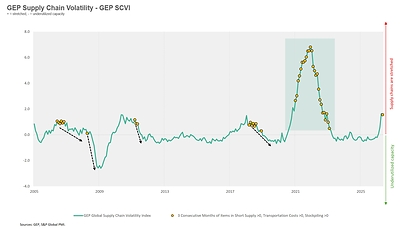
May's data also points to a rare pattern: for three consecutive months, stockpiling, shortages and transportation costs have all been elevated. Outside the 2021-23 supply chain crisis, this has typically been followed by a sharp fall in the index as supply chains self-correct (see chart below), often through weaker input demand or deteriorating economic conditions.
"The path for inflation is already being set, and companies are trying to limit the damage," said John Piatek, vice president, consulting, GEP. "The surge in purchasing we saw in April and May is likely temporary. Once companies have built inventory, they and their customers will pull back, which means supply chain pressures may ease. But, even if the Strait of Hormuz is opened fully, economic conditions will likely weaken in the second half of the year as companies will pull back on their input purchasing to draw down the inventories they've built up."
Interpreting the data:
Index > 0, supply chain capacity is being stretched. The further above 0, the more stretched supply chains are.
Index < 0, supply chain capacity is being underutilized. The further below 0, the more underutilized supply chains are.
MAY 2026 REGIONAL KEY FINDINGS
MAY 2026 KEY FINDINGS
For more information, visit www.gep.com/volatility.
Note: Full historical data dating back to January 2005 is available for subscription. Please contact economics@spglobal.com.
The next release of the GEP Global Supply Chain Volatility Index will be 8 a.m. ET, JuL. 13, 2026.
About the GEP Global Supply Chain Volatility Index
The GEP Global Supply Chain Volatility Index is produced by S&P Global and GEP. It is derived from S&P Global's PMI® surveys, sent to companies in over 40 countries, totaling around 27,000 companies. The headline figure is a weighted sum of six sub-indices derived from PMI data, PMI Comments Trackers and PMI Commodity Price & Supply Indicators compiled by S&P Global.
A Supply Chain Volatility Index is also published at a regional level for Europe, Asia, North America and the U.K. For more information about the methodology, click here.
Media Contacts
Derek Creevey | Joe Hayes | S&P Global Market Intelligence | |
Director, Public Relations | Principal Economist | Corporate Communications | |
GEP | S&P Global Market Intelligence | Email: Press.mi@spglobal.com | |
Phone: +1 646-276-4579 | Phone: +44-1344-328-099 | ||
Email: derek.creevey@gep.com | Email: joe.hayes@spglobal.com |

 View original content to download multimedia:https://www.prnewswire.co.uk/news-releases/safety-stockpiling-hits-highest-level-in-over-three-years-as-businesses-rush-to-protect-against-inflation-and-shortages-gep-global-supply-chain-volatility-index-302794584.html

Apotheken in Deutschland erhalten deutlich mehr Handlungsspielraum: Der Bundesrat hat eine Reform der schwarz-roten Koalition passieren lassen, die die Rolle der Offizinen im Gesundheitswesen spürbar aufwertet. Ziel ist es, die wohnortnahe Versorgung zu stärken, Wartezeiten in Arztpraxen zu reduzieren und Prävention sowie Früherkennung auszubauen. Das Paket war zuvor bereits vom Bundestag beschlossen worden.
Kern der Reform ist ein erweitertes Leistungsangebot in Apotheken. Künftig sollen dort zusätzliche Vorsorge- und Früherkennungsuntersuchungen möglich sein, etwa zu Herz-Kreislauf-Erkrankungen, Diabetes oder Angeboten rund um das Rauchen. Apotheken können damit stärker als bisher in der Prävention ansetzen und Risiken identifizieren, bevor es zu manifesten Erkrankungen kommt.
Auch im Impfbereich werden die Kompetenzen ausgeweitet. Neben den bereits etablierten Grippe- und Corona-Impfungen dürfen Apotheken künftig alle Schutzimpfungen mit sogenannten Totimpfstoffen anbieten, darunter etwa Tetanus. Ergänzend werden Blutabnahmen erlaubt, etwa um Medikamentenwirkungen zu kontrollieren. Damit rücken Apotheken näher an klassische ärztliche Tätigkeitsfelder heran, ohne diese vollständig zu ersetzen.
Besonders sensibel ist die neue Möglichkeit, in eng begrenzten Fällen verschreibungspflichtige Medikamente ohne ärztliche Verordnung abzugeben. Erlaubt ist künftig die einmalige Ausgabe der kleinsten Packungsgröße auf Selbstzahlerbasis, wenn ein Arzneimittel seit längerem eingenommen wird und die Fortführung der Therapie keinen Aufschub erlaubt. Die Regelung soll Versorgungslücken schließen, etwa wenn ein Rezept nicht rechtzeitig vorliegt, und bleibt zugleich strikt begrenzt, um Missbrauch zu vermeiden.