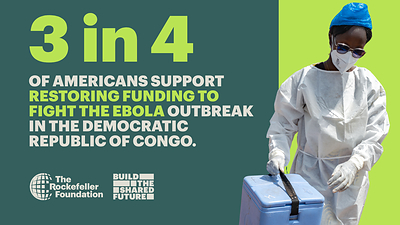
NEW YORK, June 30, 2026 /PRNewswire/ -- Echelon Insights and The Rockefeller Foundation today released findings from a new public opinion survey evaluating Americans' opinions on global aid as the nation marks one year since the official closure of the U.S. Agency for International Development (USAID) and looks ahead to America's 250th birthday. Coming on the heels of the dismantling of traditional U.S. humanitarian and development structures and historic declines in Official Development Assistance (ODA) by the world's main donors, An American Perspective on Foreign Aid shows that Americans of all ages, education levels, and political and religious affiliations support a broad range of global development programs and believe these programs are in the best interest of the United States.
The survey found that a majority of Americans (54%) have a favorable view of U.S. foreign aid, and despite differing levels of support across the political spectrum, overwhelming majorities support specific types of foreign aid work when described more specifically like humanitarian relief (90%), preventing disease outbreaks (90%), and peacekeeping and conflict resolution (78%). A significant majority of Americans (81%) favor strengthening U.S. foreign aid programs with stricter safeguards over eliminating them entirely.
"Our country's global leadership was built on the American people's conviction that building a safer, healthier, and more stable world is an investment in our own security and prosperity," said Dr. Rajiv J. Shah, President of The Rockefeller Foundation. "Despite recent decisions by leaders around the world, Americans of all political persuasions have remained consistent in supporting effective, results-driven work to prevent diseases, end conflicts, and provide lifesaving food and medicine to the suffering. This data should encourage all of us to commit to a modern, accountable approach to foreign aid that can deliver real results for the world's vulnerable in the face of 21st century challenges."
Key Findings:
The Rockefeller Foundation, in association with its affiliated public charity, RF Catalytic Capital, commissioned U.S.-based Echelon Insights to conduct the survey to establish a baseline of public attitudes toward specific foreign aid programs, identify areas of shared alignment, and measure how Americans weigh the practical outcomes of U.S. engagement abroad. The comprehensive sample comprised 2,000 adults surveyed from June 12-16, 2026 across all 50 states, balanced across party, region, age, gender, and race/ethnicity.
"Americans who are most aligned with President Trump support aid that is accountable, rooted in U.S. interests, and focused on concrete humanitarian outcomes, from preventing disease to responding to disasters to saving lives in moments of crisis," said Patrick Ruffini, founding partner at Echelon Insights. "The data show a path forward for rebuilding foreign aid programs with strong support across party lines."
Beyond the clear humanitarian mandate, the survey underscores that while there are differences in perspectives across the political spectrum, Americans view international assistance as a tangible driver of domestic security, economic growth, and global stability, and key themes emerged:
"This data is a direct rebuttal to anyone who claims Americans have lost their appetite for the world. Americans never stopped being generous; Washington just stopped delivering on it," said Dr. John A. Gans, former Chief Speechwriter at the Pentagon, author of White House Warriors, and current Senior Vice President and project lead at The Rockefeller Foundation. "250 years after America's revolution and 1 year after USAID's razing, a majority of Americans don't just want to ensure federal funding to feed the hungry, cure the sick, and respond to crisis around the world—they see good reason to increase it. The lesson for Washington is clear: don't doubt the generosity of Americans; deliver on it."
An American Perspective on Foreign Aid is the latest research to be commissioned by The Rockefeller Foundation's Build the Shared Future Initiative, through which the 113-year-old philanthropic organization aims to inspire and inform global cooperation and international development work that matches the challenges of the 21st century, including efforts to align with governments around the world to identify country-led solutions to maximize every dollar of remaining aid and to stimulate new investments.
About The Rockefeller Foundation
Investing $30 billion over the last 113 years to promote the well-being of humanity, The Rockefeller Foundation is a pioneering philanthropy built on unlikely partnerships and innovative solutions that deliver measurable results for people in the United States and around the world. We leverage scientific breakthroughs, artificial intelligence, and new technologies to make big bets across energy, food, health, and finance with our partners and our affiliated public charity, RFCC. For more information, follow us on LinkedIn @the-rockefeller-foundation, X @RockefellerFdn, Instagram @rockefellerfdn, and YouTube @RockefellerFdn, and sign up for our newsletter at www.rockefellerfoundation.org/subscribe.
 View original content to download multimedia:https://www.prnewswire.co.uk/news-releases/new-echelon-insights-survey-commissioned-by-rockefeller-foundation-most-americans-back-foreign-aid-a-year-after-usaids-end-302813668.html

Silicon Saxony schärft sein Profil als europäischer Technologiestandort – und setzt dabei zunehmend auf hochspezialisierte Anwendungen. Mit dem Zukunftscluster SEMECO (Secure Medical Microsystems and Communications) startet in Dresden die zweite Förderphase für medizinische Halbleiter, während die sächsische Halbleiter- und Softwarebranche trotz schwacher Konjunktur weiter Beschäftigung aufbaut. Branchenangaben zufolge ist die Zahl der Jobs in diesem Ökosystem binnen eines Jahres um 1.500 auf rund 82.500 zum Stichtag 30. September 2025 gestiegen, ein Plus von knapp zwei Prozent gegenüber dem Vorjahr.
SEMECO entwickelt medizinische Halbleiter als Schlüsseltechnologie für sichere, vernetzte und intelligente Medizintechnik. Für die kommenden drei Jahre erhält der Cluster im Rahmen der Clusters4Future-Initiative des Bundesministeriums für Bildung und Forschung (BMBF) bis zu 15 Millionen Euro Fördermittel. Der Freistaat Sachsen begleitet das Bündnis seit Beginn und unterstützt zusätzliche regionale Forschungs- und Entwicklungsprojekte über die EFRE-Technologieförderung 2021 bis 2027. Seine aktuellen Entwicklungen präsentiert SEMECO auf den Silicon Saxony Days, die vom 15. bis 17. Juni 2026 in Dresden stattfinden sollen.
In der zweiten Förderphase richtet SEMECO den Fokus stärker auf standardisierbare medizinische Halbleiterplattformen und deren Transfer in industrielle und klinische Anwendungen. Die spezialisierten Mikrosysteme bündeln Sensorik, Datenverarbeitung, sichere Kommunikation und KI-gestützte Funktionen, zugeschnitten auf Anforderungen der Medizintechnik. Auf Basis eines modularen Plattformansatzes entstehen kombinierbare Halbleiter-, Elektronik- und Softwarekomponenten, die sich sicher integrieren und schrittweise weiterentwickeln lassen. KI-gestützte Methoden sollen zudem Zertifizierung und Zulassung unterstützen und damit den Technologietransfer in die medizinische Praxis beschleunigen – von tragbaren Ultraschallgeräten und intelligenten Vitaldatensensoren bis zu Kommunikationsimplantaten für Menschen mit eingeschränktem Hör- und Sprachvermögen.
Parallel dazu sieht der Branchenverband Silicon Saxony den gesamten Standort vor einer neuen Wachstumsphase. Das jüngste Beschäftigungsplus verteilt sich nach Verbandsangaben nahezu gleichmäßig auf Halbleiterindustrie und Softwarebranche. Die Investitionen der vergangenen Jahre entfalteten zunehmend Wirkung, sagte Frank Schönefeld, Vorsitzender des Präsidiums von Silicon Saxony. Vor dem Hintergrund der gesamtwirtschaftlich schwachen Lage unterstreiche die Entwicklung die langfristige Attraktivität des Standorts. Entlang der gesamten Wertschöpfungskette – von großen Fabrikprojekten bis zu mittelständischen Zulieferern für Reinraum- und Fabrikinfrastruktur, Spezialgase, Chemikalienversorgung und Messtechnik – rechnet der Cluster mit zusätzlichen Impulsen durch Künstliche Intelligenz, Digitalisierung und technologische Souveränität. Die Prognose von mehr als 100.000 Beschäftigten bis zum Ende des Jahrzehnts bleibt aus Sicht des Verbands unverändert bestehen.