Meshy 7 is built around a single standard: the 3D result should agree with the image the user brought. Meshy is also publishing how it measures that agreement — geometry scored directly against reference models held out of training, not by human preference or a vision-language judge.
SILICON VALLEY, Calif., Aug. 12, 2026 /PRNewswire/ -- Meshy has released Meshy 7, its new image-to-3D foundation model, together with the method behind a new 3D geometry alignment benchmark and its first results.
WHY ALIGNMENT MATTERS NOW
The first problem with image-to-3D was whether a model could produce a usable asset at all. Broken surfaces, scrambled structure and missing limbs are now rare enough among leading models that not breaking differentiates very little.
So the question that matters has changed. An asset can look entirely reasonable and still fail to reproduce the reference: a body slightly too wide, a hand shifted out of place, an engraved line from the source image simply gone. Nothing is obviously wrong, and it is not what the user designed. That is alignment, and it separates a good 3D model from one that merely does not break.
INDUSTRY-LEADING ALIGNMENT
Given a single input image, Meshy 7 leads every model tested on all three aspects of alignment: 81.0% on overall proportion, 79.7% on spatial distribution, 59.8% on surface details — measured against four competing 3D foundation models on reference 3D models excluded from training, where 100% is the reference measured against itself. The pattern holds under the front view, the strictest condition, where Meshy 7 leads on aggregate and on each metric individually.
The lead is widest where the problem is hardest. Overall proportion is close across leading models now. Surface details is not — under single-view input no model tested reaches 60% — and this is where Meshy 7 pulls furthest ahead: 5.3 points clear of the closest competitor, more than twice its margin on either of the other two aspects. That is the shape of a real lead: not a fraction of a point where the field is already bunched together, but daylight on the dimension nobody has solved.
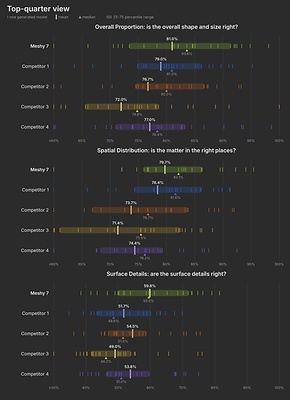
With four views the field converges: every model improves, and extra views help most on spatial distribution and surface details, the dimensions most affected by hidden geometry. The leaders end up within roughly two points of one another, and Meshy 7's single-view lead is large enough that the closest competitor catches up rather than clearly overtakes it. Single-view input is where systems separate — and it is the condition most users are in.
Compared with Meshy 6, Meshy 7 improves alignment clearly on both geometry and texture. The benchmark above covers geometry; texture is measured separately.
WHERE THE DIFFERENCE SHOWS

Three changes got it there. The image encoder now reads the input at multiple scales and accepts higher resolution, so fine shape information survives into generation instead of being averaged out. The training data was rebuilt to a stricter standard, every sample corresponding exactly to its target geometry with style, lighting and background removed. And geometry alignment became a tracked signal inside every training cycle rather than an evaluation applied at the end — the capability users care about and the number the team optimises against are now the same number.
HOW ALIGNMENT IS MEASURED
The benchmark uses neither human preference nor a vision-language judge; it compares 3D geometry directly.
Reference 3D models held out of training are rendered into input images using known cameras. Each generative model produces a 3D result from those images, which is compared against the original reference geometry — so every test image has a known 3D correct answer. Comparing renders instead would mean estimating the source camera first, mixing camera error into the geometry error being measured.
Before scoring, each generation is aligned to its reference by translation, rotation and uniform scaling only — never stretched along a single axis, so a model's own proportion errors cannot be corrected away. Agreement is then measured at three levels, from overall structure down to fine geometric difference. The reference set spans characters, vehicles, sculptures and thin-structure props, tested under three input conditions: front view, raised top-quarter view, and four views combined.
AVAILABILITY AND WHAT COMES NEXT
Meshy 7 went live on 10 August, open to all Meshy subscription tiers; downloading generated models requires the Pro tier or above. Ultra Mode currently supports single-view generation, with multi-view support arriving shortly. The benchmark described here will be released separately after launch. Geometry is only part of image-to-3D alignment — colour, material and pattern have their own — and a dedicated texture alignment benchmark will follow.
 View original content to download multimedia:https://www.prnewswire.co.uk/news-releases/meshy-releases-meshy-7-a-new-foundation-model-that-sets-a-new-bar-for-image-3d-alignment-302849385.html

Nach gut zehn Monaten Bauzeit ist die stark befahrene Bahnstrecke zwischen Hamburg und Berlin wieder vollständig in Betrieb – allerdings mit sechs Wochen Verspätung gegenüber dem ursprünglichen Zeitplan. Am frühen Morgen fuhr der erste Fernzug um 5.36 Uhr mit leichter Verspätung vom Hamburger Hauptbahnhof in Richtung Hauptstadt ab, wie die Deutsche Bahn mitteilte. Bereits seit Samstagabend nutzen Güterzüge den Korridor, seit Sonntag rollen auch wieder Fern- und Regionalzüge regulär über die sanierte Verbindung.
Für Tausende Pendlerinnen und Pendler entfällt damit der belastende Ersatzverkehr mit Bussen. Während der Generalsanierung war der Fernverkehr über Stendal und Uelzen umgeleitet worden, regionale Verbindungen zwischen Hamburg und Berlin fielen monatelang aus. Schon Mitte Mai hatte die Bahn einen ersten Teilabschnitt entlastet und die durchgehende Verbindung zwischen Hamburg und Schwerin wieder aufgenommen. Nun ist die gesamte Achse zurück im Netz – die Bahn warnt jedoch vor Anlaufschwierigkeiten und empfiehlt, Fahrzeiten vorab zu prüfen.
Die Wiederinbetriebnahme verläuft holprig. Am ersten Betriebstag sammelten sich auf der frisch sanierten Strecke Verspätungen von mindestens 15 Minuten, teils deutlich darüber. Fernzüge benötigten am Sonntag in der Regel mehr als zwei Stunden und 15 Minuten zwischen den Hauptbahnhöfen, obwohl die schnellsten ICE nach Abschluss der Arbeiten eigentlich in rund einer Stunde und 47 Minuten verkehren sollen. Hintergrund ist unter anderem, dass das für Tempo 230 ausgelegte LZB-Zugsicherungssystem auf Teilen der Trasse noch nicht abgenommen ist. Auf diesen Abschnitten gilt vorerst das PZB-System mit einer zulässigen Höchstgeschwindigkeit von 160 Stundenkilometern.
Die Bauarbeiten auf der 2025 begonnenen Generalsanierung umfassten nach Bahnangaben die Erneuerung von 165 Kilometern Gleisen und die Instandsetzung weiterer 61 Kilometer. Zudem wurden 249 Weichen eingebaut und 28 Bahnhöfe modernisiert. Der ursprünglich bis Ende April angesetzte Abschluss verzögerte sich durch einen harten Winter und gefrorenen Boden, der den Zeitpuffer aufbrauchte. Mit der jetzt abgeschlossenen Kernsanierung ist die Verbindung zwischen den beiden größten deutschen Städten infrastrukturell deutlich erneuert, ihre geplante Höchstleistung im Fahrplanbetrieb dürfte aber erst erreicht werden, wenn die technischen Zugsicherungssysteme auf der gesamten Strecke vollumfänglich verfügbar sind.