New agentic AI capability continuously monitors selected industries and topics, giving business leaders a current view of market change without requiring a dedicated analyst team.
BERLIN, Sept. 16, 2026 /PRNewswire/ -- Market Logic Software today announced the general availability of DeepSights Radar, a new capability in its AI-powered market intelligence platform, DeepSights. DeepSights Radar autonomously monitors, analyzes and synthesizes developments across selected industries and topics, helping companies spot market developments before they become urgent risks or missed opportunities.
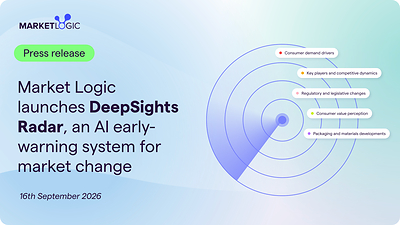
Insights teams are under pressure to follow more sources, competitors and market signals, often without additional headcount. The result is a growing gap between the volume of information available and the capacity to turn it into timely intelligence for business stakeholders in strategy, product, innovation and marketing. DeepSights Radar is designed to help close that gap by providing 24/7 access to an up-to-date view of strategic markets and topics from one place.
Expert AI agents analyze new market signals
AI agents that keep a living picture of the market
DeepSights Radar uses always-on AI agents that read every piece of research flowing into a customer's DeepSights platform against a definition of what matters to that business, in its own vocabulary. Rather than summarizing a fixed set of documents, the agents build up a living body of market understanding: they recognize the competitors, trends, regulatory developments and other forces that qualify, and maintain a structured, multi-chapter profile on each. Every new piece of research deepens that understanding, with every claim traceable to its source. A New Learnings summary highlights what has changed since the last version, so users can easily read about the shift rather than going over the entire profile from scratch.
Two ways to monitor: industry radar and topic radar
DeepSights Radar is available in two modes: Industry Radar and Topic Radar.
Industry Radar tracks change across a vertical market and identifies emerging trends and issues customers may not yet be following. Market Logic is launching with three out-of-the-box industry radars: consumer packaged goods (CPG), over the counter (OTC) healthcare and retail. Each radar is pre-tuned to the industry's acronyms, dynamics and KPIs and includes 12 ready-to-use radars organized around four dimensions: demand, supply, regulatory and legislative change, and competitive activity. With expert services support, new Industry Radars can go live within a few days.
Topic Radar provides ongoing monitoring of specific themes and topics a customer has identified as strategically important. A self-service setup, guided by a short briefing wizard, allows companies to set a new radar live within hours.
Built for active intelligence
The Radar launch reflects Market Logic's focus on active intelligence: AI-supported systems that identify new market signals, alert users to important developments and help teams act earlier on evidence rather than intuition.
"Business and insights leaders do not lack data. They lack the time and resources to turn it into a dependable, current view of their market. DeepSights Radar does that continuously, so they can act early and seize competitive advantage," said Olaf Lenzmann, Chief Product and Innovation Officer, Market Logic Software.
DeepSights Radar is generally available for new and existing DeepSights customers.
About Market Logic Software
Market Logic Software is a provider of pioneering market intelligence and insights solutions. Its AI-enabled platform, DeepSights, helps organizations make research and market intelligence available to decision-makers across the enterprise at scale and speed. For more than 15 years, Market Logic has worked with consumer-focused brands around the world to support insights-driven decision-making. Customers include Vodafone, Bayer and Philips. More information is available at https://marketlogicsoftware.com.
 View original content to download multimedia:https://www.prnewswire.co.uk/news-releases/market-logic-software-launches-deepsights-radar-an-ai-early-warning-system-for-market-change-302880205.html

Die Exzellenzstrategie von Bund und Ländern stellt die Weichen für die nächste Förderperiode – und verschiebt die Gewichte im deutschen Wissenschaftssystem. Zu den bundesweit fünf neuen Exzellenzstandorten gehören die Technische Universität Darmstadt, die Goethe-Universität Frankfurt und die Johannes Gutenberg-Universität Mainz, die sich als Allianz der Rhein-Main-Universitäten (RMU) durchgesetzt haben. Ebenfalls erfolgreich waren in Nordrhein-Westfalen die Universität zu Köln sowie der Verbund Ruhr Innovation Lab aus TU Dortmund und Ruhr-Universität Bochum.
Für Hessen ist die Entscheidung ein Durchbruch: Erstmals tragen Universitäten des Landes ab 2027 den Titel „Exzellenzuniversität“. Die RMU-Allianz erhält nach Angaben des hessischen Wissenschaftsministeriums über sieben Jahre eine Förderung von insgesamt bis zu 155 Millionen Euro, finanziert zu 75 Prozent vom Bund. Wissenschaftsminister Timon Gremmels spricht von den ersten Exzellenzunis in Hessen und zugleich vom ersten länderübergreifenden Verbund in der Exzellenzstrategie. Ministerpräsident Boris Rhein bezeichnet den Titel als Meilenstein für die Forschungslandschaft des Landes. Ein mittelhessischer Verbund aus den Universitäten Gießen und Marburg blieb im Wettbewerb dagegen ohne Erfolg.
Auch Nordrhein-Westfalen stärkt seine Rolle als Hochburg der Spitzenforschung. Neben der Universität Köln, die den begehrten Status nach einer früheren Förderphase von 2012 bis 2019 zurückerhält, steigt der Verbund aus TU Dortmund und Ruhr-Uni Bochum als Ruhr Innovation Lab in den Kreis der Exzellenzuniversitäten auf. Nach Angaben des Düsseldorfer Wissenschaftsministeriums baut das Land damit seine Führungsposition aus. Die Universität Bonn und die RWTH Aachen hatten ihren Exzellenzstatus bereits im Frühjahr verteidigt, sodass NRW künftig mit vier Standorten vertreten ist. Ministerpräsident Hendrik Wüst wertet dies insbesondere als Signal für die internationale Sichtbarkeit des Ruhrgebiets als Wissenschafts- und Innovationsstandort.
In Bonn gaben Bundesforschungsministerin Dorothee Bär und der niedersächsische Wissenschaftsminister Falko Mohrs als Vize-Vorsitzender der Gemeinsamen Wissenschaftskonferenz (GWK) neben den Standorten in Hessen und NRW auch die Universitäten Freiburg und Jena als neue Exzellenzunis bekannt. Für Einzeluniversitäten sieht das Programm Fördermittel von bis zu 15 Millionen Euro pro Jahr vor, bei Verbünden wie der Rhein-Main-Allianz oder dem Ruhr Innovation Lab können es bis zu 28 Millionen Euro sein. Damit wächst die Riege der Exzellenzuniversitäten, deren bisher neun Standorte – darunter Aachen, Bonn, Dresden, Hamburg, Heidelberg, Karlsruhe, München, Tübingen sowie die Berlin University Alliance – ihre Förderung bereits im Frühjahr um weitere sieben Jahre verlängert hatten. Der Titel ist jeweils an regelmäßige Überprüfungen der Fördervoraussetzungen geknüpft.