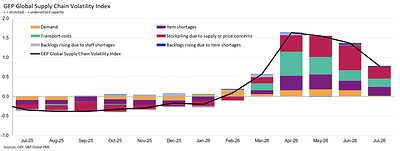
CLARK, N.J., Aug. 12, 2026 /PRNewswire/ -- GEP Global Supply Chain Volatility Index — a leading indicator tracking demand conditions, shortages, transportation costs, inventories and backlogs, based on a monthly survey of 27,000 businesses — showed global supply chain pressures eased in July as manufacturers reduced precautionary stockpiling and transportation pressures moderated. However, supply shortages remained elevated and production backlogs continued to build, indicating supply chains had yet to fully recover before the renewed disruption in the Strait of Hormuz.
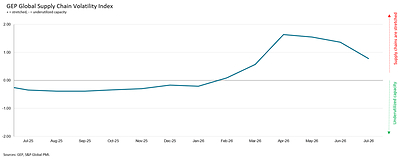
The survey was mostly conducted before the latest escalation in the Middle East and renewed disruption to shipping through the Strait of Hormuz, providing a snapshot of global supply chains immediately before energy prices and geopolitical uncertainty increased again.
Manufacturers scaled back safety-stock building in July following a three-and-a-half-year peak in the second quarter of 2026, suggesting businesses believed supply risks were beginning to ease. Transportation costs also moderated, helping drive the overall improvement in global supply chain conditions.
Despite the easing, reports of critical items in short supply remained elevated globally, while manufacturers continued reporting rising production backlogs caused by missing materials and components. This indicates supply bottlenecks remain unresolved and could worsen if geopolitical tensions persist.
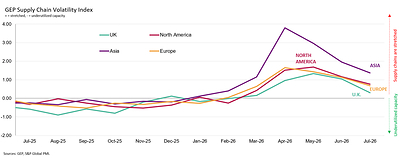
Demand for raw materials and commodities remained strongest across Asia and North America, where manufacturers continued purchasing inputs at a significantly faster pace than other major regions. Europe, by contrast, remained comparatively subdued, reflecting weaker manufacturing order books and lower inventory building.
Interpreting the data:
Index > 0, supply chain capacity is being stretched. The further above 0, the more stretched supply chains are.
Index < 0, supply chain capacity is being underutilized. The further below 0, the more underutilized supply chains are.
JULY 2026 REGIONAL KEY FINDINGS
JULY 2026 KEY FINDINGS
For more information, visit www.gep.com/volatility.
Note: Full historical data dating back to January 2005 is available for subscription. Please contact economics@spglobal.com.
The next release of the GEP Global Supply Chain Volatility Index will be 8 a.m. ET, Sep. 11, 2026.
About the GEP Global Supply Chain Volatility Index
The GEP Global Supply Chain Volatility Index is produced by S&P Global and GEP. It is derived from S&P Global's PMI® surveys, sent to companies in over 40 countries, totaling around 27,000 companies. The headline figure is a weighted sum of six sub-indices derived from PMI data, PMI Comments Trackers and PMI Commodity Price & Supply Indicators compiled by S&P Global.
A Supply Chain Volatility Index is also published at a regional level for Europe, Asia, North America and the U.K. For more information about the methodology, click here.
Media Contacts
Derek Creevey
Director, Public Relations
GEP
Phone: +1 646-276-4579
Email: derek.creevey@gep.com
Joe Hayes
Senior Principal Economist
S&P Global Market Intelligence
Phone: +44-1344-328-099
Email: joe.hayes@spglobal.com
S&P Global Market Intelligence
Corporate Communications
Email: Press.mi@spglobal.com

 View original content to download multimedia:https://www.prnewswire.co.uk/news-releases/global-supply-chain-pressures-ease-in-july-but-shortages-persist-ahead-of-renewed-strait-of-hormuz-disruption-gep-global-supply-chain-volatility-index-302849802.html

Die Berliner Linken-Politikerin Elif Eralp geht juristisch gegen Bundesinnenminister Alexander Dobrindt (CSU) vor. Eralp und ihr Berliner Landesverband haben nach Angaben ihres Rechtsbeistands Strafanzeige beziehungsweise Strafantrag gegen den Minister gestellt. Hintergrund ist eine Passage in der ZDF-Talkshow „Maybrit Illner“, in der sich die Moderatorin versprochen und Eralp in einem Satz fälschlich als Antisemitin bezeichnet hatte, bevor sie sich sofort korrigierte. Dobrindt kommentierte diese Szene mit den Worten „Na doch“.
Aus Sicht des von Eralp mandatierten Anwalts Jasper Prigge macht sich der Minister damit den Versprecher der Moderatorin zu eigen. In einem Schriftsatz, der mehreren Medien vorliegt, heißt es, Dobrindt stelle durch seine Einlassung eine Tatsachenbehauptung auf, die den Tatbestand der üblen Nachrede erfülle. Zudem liege eine Beleidigung vor, weil die Bezeichnung als Antisemitin „in erheblichem Maße ehrabträglich“ sei. Eralp habe sich nach Darstellung ihres Anwalts selbst nie in einer Weise geäußert, die als antisemitisch zu bezeichnen wäre, vielmehr trete sie öffentlich für den Schutz jüdischen Lebens ein.
Der Anwalt spricht von einer „Falschbehauptung des Innenministers“. Die Äußerung im Fernsehen sei geeignet, das öffentliche Wirken der Berliner Spitzenpolitikerin erheblich zu erschweren. In dem Schriftsatz wird darauf verwiesen, dass die Verbreitung des Eindrucks, Eralp würde selbst sagen, sie sei Antisemitin, ihre Integrität als politische Amtsträgerin infrage stellen und damit auch Auswirkungen auf politische Prozesse in Berlin haben könne. Eralp ist Spitzenkandidatin der Linken für das Rote Rathaus.
Die Auseinandersetzung hatte sich in der ZDF-Sendung an einem Schlagabtausch zwischen Dobrindt und der Linken-Bundestagsfraktionschefin Heidi Reichinnek entzündet. Während der Debatte unterlief Moderatorin Maybrit Illner der Versprecher, sie korrigierte sich jedoch unmittelbar mit dem Hinweis, Eralp sei „keine Antisemitin“. Dobrindts anschließender Kommentar bildet nun den Kern des juristischen Streits. Zu möglichen weiteren Schritten der Strafverfolgungsbehörden und einer Reaktion des Bundesinnenministers lagen zunächst keine näheren Angaben vor.