MUNICH, June 23, 2026 /PRNewswire/ -- GCL System Integration Technology Co., Ltd. ("GCL SI" or "the Company") has announced at Intersolar Europe 2026 held from June 23 to 25 in Munich to officially establish back-contact (BC) cell technology as the core strategic pillar of its next-generation photovoltaic roadmap, as a response to the rising demand for high-efficiency, aesthetically driven solutions. It also unveiled the GPC 3.0 full-screen all-black module at one of the most influential solar industry trade fairs worldwide.
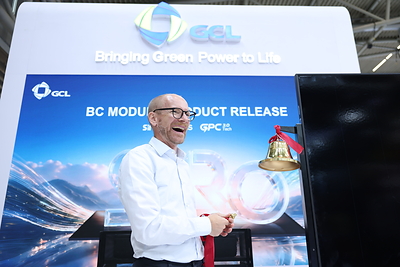
As China's solar sector faces mounting efficiency bottlenecks and increasingly diverse end-market demands, the shift to BC technology is driven by both evolving market needs and the company's accumulated expertise in passivation and contact techniques.
"BC is the ultimate architecture for crystalline silicon cells," said GengWeng Huang, Executive Dean of GCL SI's Cell Research Division. "We've already explored TOPCon and HJT extensively, but both are reaching their physical limits. BC is opening a broader window for future efficiency gains."
GCL SI's GPC (Graphical Precise-doping Passivation Contact) product line is its flagship BC technology development. GPC 3.0 targets the premium distributed segment of residential rooftops, C&I rooftops, and BIPV-style applications, where full-screen all-black aesthetics, higher energy yield, and stronger reliability are increasingly valued. GCL SI describes GPC 3.0 as a high-efficiency BC-based module designed to deliver greater real-world rooftop value.
Notably, GCL SI confirmed that the first containers of GPC 3.0 modules are already on their way to Europe, marking the beginning of its commercial rollout in the European distributed solar market.
The GPC residential full-screen all-black modules offer a proven benchmark: 475–500 W output, 23.27%–24.05% efficiency, dimensions of 1,800 × 1,134 × 30 mm, a 30-year linear power warranty with 0.35% annual degradation, and a 30-year product warranty. GCL SI has indicated that GPC 3.0 is designed to further enhance both efficiency and reliability beyond this baseline.
According to GCL SI, GPC 3.0 integrates several upgraded technologies including MAX design, advanced passivation, multi-layer gradient dielectric films, GPC metallization, and FBR granular silicon, to boost module efficiency, durability, and suitability across distributed scenarios. The technology offers four core advantages:
Looking ahead, GCL SI is committed to driving the global large‑scale adoption of BC technology to support worldwide carbon neutrality goals. With GPC 3.0 as a strategic cornerstone, the company will continue pushing efficiency boundaries and low‑carbon innovation across distributed solar applications, and to build a cleaner, more resilient energy future.
 View original content to download multimedia:https://www.prnewswire.co.uk/news-releases/gcl-si-officially-launches-back-contact-modules-at-intersolar-europe-2026-302808216.html

Die Zahl der Demenzerkrankungen in Deutschland könnte bis 2060 deutlich ansteigen und das Versorgungssystem spürbar unter Druck setzen. Nach neuen Prognosen des Wissenschaftlichen Instituts der AOK (WIdO) dürfte die Zahl der Betroffenen bei weiter steigender Lebenserwartung von derzeit rund 1,3 Millionen auf bis zu 2,1 Millionen zunehmen. Grundlage der Berechnungen ist ein kleinräumiges Prognoseverfahren, das das Institut gemeinsam mit den Universitäten Trier, Rostock und Köln entwickelt hat.
Die Analyse reicht hinunter bis auf die Ebene von 400 Kreisen und kreisfreien Städten und macht deutliche regionale Unterschiede sichtbar. Bereits 2020 lag der Anteil der Demenzkranken zwischen 1,0 Prozent in Tübingen und 2,6 Prozent in der brandenburgischen Prignitz. Für das Jahr 2060 erwarten die Forscher eine Spanne von 1,7 Prozent Demenzkranken in München bis zu 6,2 Prozent im Landkreis Elbe-Elster in Brandenburg. Besonders betroffen sind damit vor allem ländliche Regionen im Osten, die überdurchschnittlich altern.
Parallel zur wachsenden Zahl von Demenzfällen schrumpft der Pool potenzieller Pflege- und Betreuungspersonen im Erwerbsalter. Laut Studie kamen im Jahr 2020 rechnerisch noch 38 Menschen im erwerbsfähigen Alter auf einen Demenzfall. Bis 2060 dürfte dieses Verhältnis auf 21 Erwerbspersonen pro Fall sinken. Damit würden deutlich mehr Erkrankte von einer deutlich kleineren Zahl potenziell Erwerbstätiger versorgt werden müssen – mit entsprechenden Konsequenzen für Pflegeinfrastruktur, Kommunen und Sozialversicherungen.
Die Autoren der Studie betonen zugleich, dass der prognostizierte Anstieg nicht zwangsläufig ist. Nach heutigem wissenschaftlichem Stand lassen sich Demenzrisiken durch Prävention spürbar senken. Eine konsequentere Behandlung von Bluthochdruck und Diabetes, der Verzicht auf Rauchen oder ein höheres Bildungsniveau könnten dazu beitragen, etwa die Hälfte der Neuerkrankungen zu vermeiden. In einem solchen Szenario würde sich die Zahl der Demenzfälle im Jahr 2060 nicht weiter erhöhen, sondern sich auf einem Niveau zwischen 1,3 und 1,5 Millionen stabilisieren. Die Spannbreite der Projektionen zeigt damit, wie stark der künftige Versorgungsdruck von heute eingeleiteten Präventionsstrategien abhängen dürfte.