SUZHOU, China, May 25, 2026 /PRNewswire/ -- GCL System Integration (GCL SI) joined partners and stakeholders at Getz Energy's "Getz Energy Open House: Welcome to the Smart Energy Revolution" to explore trends in large-scale solar deployment and smart energy integration as Thailand accelerates renewable energy development.
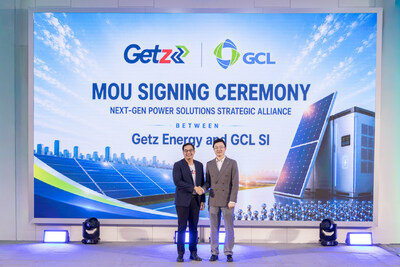
At the event, GCL SI and Getz Energy Company Limited (Getz), a wholly-owned subsidiary of Global Power Synergy Public Company Limited (GPSC), signed a Memorandum of Understanding (MOU) covering the planned supply of up to 1 GW equivalent of photovoltaic modules over the next three years, supporting the expansion of solar generation capacity in Thailand.
The agreement aligns with GPSC's long-term renewable energy strategy while strengthening Getz Energy's role in Thailand's growing clean energy market through utility-scale solar projects and intelligent energy management solutions. The partnership also reinforces both companies' focus on next-generation solar technologies and regional energy infrastructure development.
Under the agreement, GCL SI will supply its photovoltaic modules and battery energy storage systems for large-scale solar and hybrid solar applications. Deliveries are expected to be phased to match construction and grid connection schedules, ensuring timely module supply throughout project execution.
Showcasing Advanced Module Technologies at Getz Open House
At the exhibition, GCL SI showcased several flagship products, including the SiRo T Series NT12/66GDF module, as well as the SiRo B Series NR12R/66GDF and NR10R/54BGDF modules. Corresponding solar cells were also displayed alongside the modules, giving visitors a closer look at GCL SI's latest cell technologies and manufacturing capabilities.
Designed for utility-scale and industrial applications, the SiRo T series integrates advanced TOPCon 2.0 technology, bifacial power generation capability, enhanced operational stability, and long-term durability to support reliable energy output under demanding real-world operating conditions. Optimized for industrial rooftops, large-scale solar installations, and high-temperature environments, the series is engineered to deliver stable, cost-effective performance across the project lifecycle.
Meanwhile, the SiRo B Series, built on GCL's advanced GPC technology, combines high conversion efficiency with enhanced visual integration for premium distributed solar applications. Featuring ultra-low reflectivity films, high-purity FBR granular silicon, and advanced passivation technologies, the series is engineered to deliver strong performance while maintaining a refined visual profile.
Expanding Renewable Energy Cooperation Across Southeast Asia
For Getz and GPSC, the power and energy flagship of the PTT Group, the agreement supports the continued growth of their renewable energy portfolio, with utility-scale solar serving as a key component of the group's long-term low-carbon generation strategy.
For GCL SI, the MOU further strengthens its presence in Southeast Asia's solar market and reinforces its position in Thailand's renewable energy market. The agreement also reflects the company's growing role in meeting regional demand for higher-efficiency photovoltaic technologies used in large-scale solar applications.
More broadly, the partnership highlights the rapid growth of utility-scale renewable energy development across Southeast Asia, where rising electricity demand, grid modernization, and decarbonization targets are driving investment in next-generation solar infrastructure.
Photo - https://mma.prnewswire.com/media/2986839/20260522094401_44_1123.jpg
 View original content:https://www.prnewswire.co.uk/news-releases/gcl-si-and-getz-energy-sign-mou-for-1-gw-of-advanced-pv-modules-to-support-thailands-clean-energy-transition-302780966.html

Die von US-Präsident Donald Trump angekündigten Zölle von 25 Prozent auf Neuwagenimporte aus der Europäischen Union würden nach Einschätzung von Branchenexperten vor allem die deutsche Autoindustrie treffen. Berechnungen des Center Automotive Research (CAR) in Bochum zufolge kämen allein auf die Autoproduktion in Deutschland zusätzliche Belastungen von rund 2,5 Milliarden Euro pro Jahr zu. Hinzu kämen weitere Kosten für US-Exporte deutscher Hersteller aus Werken in anderen EU-Staaten.
Obwohl sich die Maßnahmen formal gegen die gesamte EU richten, sieht CAR-Direktor Ferdinand Dudenhöffer insbesondere Deutschland im Visier Washingtons. Die Exporte anderer ausländischer Autobauer in die USA seien „unwesentlich“, sagte er und sprach mit Blick auf die neuen Zoll-Drohungen vom möglichen Beginn eines „Wirtschaftskriegs gegen Deutschland“. Die Maßnahmen würden die Hersteller jedoch unterschiedlich hart treffen, abhängig von ihrer Produktionsstruktur und Präsenz in den Vereinigten Staaten.
Relativ besser gestellt wären demnach Konzerne wie BMW und Mercedes-Benz, die über umfangreiche Produktionskapazitäten in den USA verfügen. In ihren US-Werken fertigen sie vor allem SUV-Modelle, die den Großteil ihrer Verkäufe auf dem US-Markt ausmachen. Diese lokale Produktion wirkt nach Einschätzung Dudenhöffers wie ein „Zollschutz“, weil in den USA montierte Fahrzeuge nicht unter die geplanten Importzölle auf Neuwagen aus der EU fallen würden.
Deutlich verwundbarer wären dagegen Marken wie Audi und Porsche, die ihre Fahrzeuge bislang weitgehend aus Europa in die USA liefern. Für sie könnten die neuen Einfuhrabgaben ein Anreiz sein, Pläne zum Aufbau eigener Produktionsstätten in den Vereinigten Staaten zu beschleunigen. Vollständig auffangen können die Hersteller die zusätzlichen Kosten nach Einschätzung des CAR-Instituts jedoch nicht. Ein Teil der Belastungen dürfte über Preiserhöhungen an die US-Käufer weitergegeben werden. Dank der starken Markenbindung rechnet Dudenhöffer zwar nicht mit einem abrupten Nachfrageeinbruch, die deutschen Autobauer stünden jedoch vor der Herausforderung, ihre Preissetzung und Standortstrategie zügig an die neue handelspolitische Lage anzupassen.