SHENZHEN, China, June 23, 2026 /PRNewswire/ -- During MWC Shanghai 2026, Fibocom launched the storage-optimized FG550-EAU, a 5G module based on the Samsung Exynos Modem platform. The module optimizes its RAM configuration from LPDDR4x 8Gb to LPDDR4x 4Gb, streamlining RAM capacity by 50%, while retaining business functions and customer-specific customization capabilities.
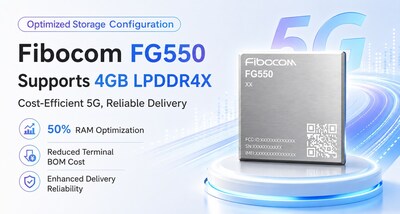
As AI server and data center demand intensifies memory shortages and price volatility, memory cost and availability have become key factors affecting 5G terminal commercialization. The optimization addresses cost control and stable delivery requirements in mass production, helping customers reduce terminal BOM costs, strengthen supply chain resilience, and improve deployment certainty.
Based on actual terminal operating requirements, Fibocom implemented refined RAM optimization through low-level code review, memory scheduling optimization, and precise system resource allocation, enabling stable deployment with the 4Gb configuration. The optimized FG550-EAU retains key product features, while improving resource utilization, operating experience, and power efficiency.
The FG550-EAU supports 3GPP Rel.16 and NR 5CC carrier aggregation. It is backward compatible with LTE Cat.20, supporting 4G/5G dual-mode connectivity across mainstream global networks.
"Samsung Exynos Modem and Fibocom share a strong and enduring partnership. This RAM optimization solution highlights Fibocom's outstanding engineering expertise and professionalism," said Xuebao Pan, senior vice president and head of System LSI R&D Center at Samsung Semiconductor China Research. "We highly value this breakthrough in balancing performance and cost, and look forward to continuing our collaboration to empower next-generation 5G terminals."
This storage optimization marks another customer-oriented technical innovation by Fibocom around mass-production requirements. Fibocom will continue to leverage its 5G connectivity, platform adaptation, and supply chain management capabilities to work with global FWA, mobile broadband, and IoT customers in building 5G terminal products with stronger cost competitiveness and delivery certainty.
About Fibocom
Fibocom is China's first wireless communication module company listed on both the A-share and H-share markets. As a global leading provider of wireless communication modules and AI solutions, Fibocom leverages wireless communication and artificial intelligence as its core technologies to provide integrated hardware and software solutions that empower industry applications.
Fibocom's one-stop solutions encompass cellular communication, AI, automotive, and GNSS modules, as well as AI toolchains, supporting industry-side and mainstream large model integration, and providing AI Agent, global connectivity, and cloud services, driving the digital intelligence upgrades in industries such as robotics, consumer electronics, low-altitude economy, intelligent transportation, smart retail, and smart energy.

Photo - https://mma.prnewswire.com/media/2998143/0ABB7C93_11C6_429C_93DA_2548B67F227E.jpg
Logo - https://mma.prnewswire.com/media/2429567/LOGO_Logo.jpg
 View original content:https://www.prnewswire.co.uk/news-releases/fibocom-achieves-4gb-lpddr4x-memory-optimization-on-fg550-strengthening-cost-and-supply-competitiveness-for-5g-devices-302806505.html

Silicon Saxony schärft sein Profil als europäischer Technologiestandort – und setzt dabei zunehmend auf hochspezialisierte Anwendungen. Mit dem Zukunftscluster SEMECO (Secure Medical Microsystems and Communications) startet in Dresden die zweite Förderphase für medizinische Halbleiter, während die sächsische Halbleiter- und Softwarebranche trotz schwacher Konjunktur weiter Beschäftigung aufbaut. Branchenangaben zufolge ist die Zahl der Jobs in diesem Ökosystem binnen eines Jahres um 1.500 auf rund 82.500 zum Stichtag 30. September 2025 gestiegen, ein Plus von knapp zwei Prozent gegenüber dem Vorjahr.
SEMECO entwickelt medizinische Halbleiter als Schlüsseltechnologie für sichere, vernetzte und intelligente Medizintechnik. Für die kommenden drei Jahre erhält der Cluster im Rahmen der Clusters4Future-Initiative des Bundesministeriums für Bildung und Forschung (BMBF) bis zu 15 Millionen Euro Fördermittel. Der Freistaat Sachsen begleitet das Bündnis seit Beginn und unterstützt zusätzliche regionale Forschungs- und Entwicklungsprojekte über die EFRE-Technologieförderung 2021 bis 2027. Seine aktuellen Entwicklungen präsentiert SEMECO auf den Silicon Saxony Days, die vom 15. bis 17. Juni 2026 in Dresden stattfinden sollen.
In der zweiten Förderphase richtet SEMECO den Fokus stärker auf standardisierbare medizinische Halbleiterplattformen und deren Transfer in industrielle und klinische Anwendungen. Die spezialisierten Mikrosysteme bündeln Sensorik, Datenverarbeitung, sichere Kommunikation und KI-gestützte Funktionen, zugeschnitten auf Anforderungen der Medizintechnik. Auf Basis eines modularen Plattformansatzes entstehen kombinierbare Halbleiter-, Elektronik- und Softwarekomponenten, die sich sicher integrieren und schrittweise weiterentwickeln lassen. KI-gestützte Methoden sollen zudem Zertifizierung und Zulassung unterstützen und damit den Technologietransfer in die medizinische Praxis beschleunigen – von tragbaren Ultraschallgeräten und intelligenten Vitaldatensensoren bis zu Kommunikationsimplantaten für Menschen mit eingeschränktem Hör- und Sprachvermögen.
Parallel dazu sieht der Branchenverband Silicon Saxony den gesamten Standort vor einer neuen Wachstumsphase. Das jüngste Beschäftigungsplus verteilt sich nach Verbandsangaben nahezu gleichmäßig auf Halbleiterindustrie und Softwarebranche. Die Investitionen der vergangenen Jahre entfalteten zunehmend Wirkung, sagte Frank Schönefeld, Vorsitzender des Präsidiums von Silicon Saxony. Vor dem Hintergrund der gesamtwirtschaftlich schwachen Lage unterstreiche die Entwicklung die langfristige Attraktivität des Standorts. Entlang der gesamten Wertschöpfungskette – von großen Fabrikprojekten bis zu mittelständischen Zulieferern für Reinraum- und Fabrikinfrastruktur, Spezialgase, Chemikalienversorgung und Messtechnik – rechnet der Cluster mit zusätzlichen Impulsen durch Künstliche Intelligenz, Digitalisierung und technologische Souveränität. Die Prognose von mehr als 100.000 Beschäftigten bis zum Ende des Jahrzehnts bleibt aus Sicht des Verbands unverändert bestehen.