SEOUL, South Korea, June 8, 2026 /PRNewswire/ -- Dayspring Pharma, a clinical-stage biotechnology company focused on innovative dermatology therapies, announced the first public disclosure of positive topline results from its Phase II randomized, double-blind, placebo-controlled trial of CG2001 at the 14th World Congress for Hair Research (WCHR) in Seoul, South Korea. The results were presented orally by Professor Cheng Zhou, Director of the Department of Dermatology at Peking University People's Hospital.
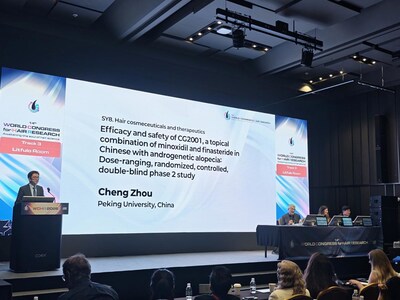
CG2001 is a topical fixed-dose combination formulation containing minoxidil and finasteride, being evaluated for the treatment of male androgenetic alopecia.
The trial consisted of the following treatment arms: CG2001 (5% Minoxidil and 0.075% Finasteride) once daily (QD); CG2001 (5% Minoxidil and 0.1% Finasteride) once daily (QD); CG2001 (5% Minoxidil and 0.075% Finasteride) twice daily (BID); and a Control Group.
The study met its primary endpoint: at Week 24, the group treated with CG2001 (5% Minoxidil and 0.075% Finasteride) twice daily demonstrated a statistically significant improvement in the change from baseline in Target Area Hair Count (TAHC) compared to the placebo group. Additionally, favorable safety and tolerability results were observed.
Key topline results include:
"Despite approved treatment options, androgenetic alopecia remains an area of significant unmet medical need. We are encouraged by the Phase II results, which support CG2001's potential as a differentiated treatment option and its continued clinical development," said Baohui Yu, CEO of Dayspring Pharma.
Dayspring Pharma is currently engaging with regulatory authorities to define the next phase of clinical development.
About CG2001
CG2001 is a topical combination of minoxidil and finasteride developed to harness the synergistic potential of two cornerstone therapies for AGA. Both are widely recognized as first-line treatments for male pattern hair loss: minoxidil promotes hair growth, while finasteride inhibits 5α-reductase and reduces dihydrotestosterone levels.
CG2001 is formulated as a specifically designed foam with an optimized dose ratio and delivery system to improve local follicular delivery, enhance efficacy, and minimize systemic exposure associated with oral finasteride.
About Dayspring Pharma
Dayspring Pharma is a pharmaceutical company focused on innovation in dermatology and hair health. The company develops differentiated therapies to address unmet clinical needs. For more information, please visit dayspringpharma.com.
Contact: Dayspring Pharma, chenguang@dayspringpharma.com
Photo - https://mma.prnewswire.com/media/2993074/image1.jpg
 View original content:https://www.prnewswire.co.uk/news-releases/dayspring-pharma-announces-positive-topline-results-from-phase-ii-clinical-trial-of-cg2001-for-the-treatment-of-androgenetic-alopecia-aga-302792544.html

Im Streit um die Behandlung sogenannter Heavy User im Mobilfunk hat das nordrhein-westfälische Oberverwaltungsgericht (OVG) die Bundesnetzagentur vorläufig in die Schranken gewiesen. Die Bonner Aufsichtsbehörde hatte einem bundesweit tätigen Mobilfunkanbieter untersagt, Kunden mit unbegrenztem oder sehr großem Datenvolumen bei überlasteten Funkzellen mit geringerer Priorität zu bedienen. Diese Form der sogenannten Depriorisierung darf nach der einstweiligen OVG-Entscheidung vorerst weiter angewendet werden. Der Beschluss im Eilverfahren ist nicht anfechtbar.
Nach Auffassung des 13. Senats ist derzeit offen, ob die entsprechende Vertragsklausel des Anbieters mit europäischem Recht vereinbar ist. Im Kern geht es um die Frage, ob eine nachrangige Behandlung von Vielnutzern eine nicht gerechtfertigte Ungleichbehandlung von Kunden darstellt. Bevor in der Hauptsache entschieden wird, will das OVG Münster den Europäischen Gerichtshof (EuGH) um eine Vorabentscheidung bitten. Damit wird der Konflikt um Datenpriorisierung und Netzmanagement auf die europäische Ebene verlagert.
Gegenstand des Verfahrens ist insbesondere, ob der Datentransport datenintensiver Anwendungen wie hochauflösendem Videostreaming während einer Netzüberlastung eingeschränkt oder verlangsamt werden darf. Der betroffene Mobilfunkanbieter sieht dies in seinen Allgemeinen Geschäftsbedingungen vor, um Kapazitäten in ausgelasteten Funkzellen zu steuern. Die Bundesnetzagentur hatte angeordnet, dass diese Klausel nicht umgesetzt werden darf und damit faktisch einen Riegel vor entsprechende Maßnahmen gegen Heavy User geschoben.
In der Vorinstanz hatte sich die Bundesnetzagentur noch durchgesetzt: Das Verwaltungsgericht Köln hatte die Position der Behörde bestätigt. Das OVG änderte diese Entscheidung nun (Az. 13 B 1232/25) und gab dem Anbieter im Eilverfahren Recht. Mit der geplanten Vorlage an den EuGH dürfte der Fall Signalwirkung für die Auslegung europäischer Vorgaben zur Gleichbehandlung von Internetverkehr und zu den Spielräumen der Netzbetreiber beim Umgang mit stark belasteten Mobilfunkzellen entfalten.