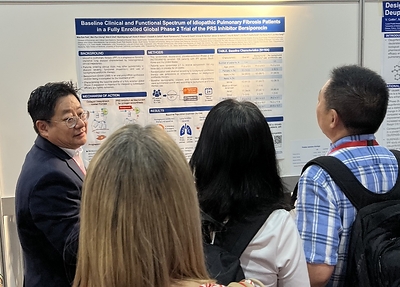
BARCELONA, Spain and SEOUL, South Korea, Sept. 24, 2026 /PRNewswire/ -- Daewoong Pharmaceutical (Co-CEOs Seongsoo Park and Changjae Lee) announced that it presented a poster on the baseline characteristics of all 104 patients enrolled in the global Phase 2 clinical trial of its idiopathic pulmonary fibrosis (IPF) drug candidate 'Bersiporocin (DWN12088)' at the European Respiratory Society (ERS) Congress 2026, held on September 6 (local time) in Barcelona, Spain.
Idiopathic Pulmonary Fibrosis is a disease in which various inflammatory and fibrotic signals interact, leading to excessive production and accumulation of collagen. Bersiporocin, being developed by Daewoong Pharmaceutical, selectively inhibits prolyl-tRNA synthetase (PRS), thereby reducing excessive collagen production associated with fibrosis.
Bersiporocin has a differentiated mechanism of action that targets collagen synthesis downstream of multiple profibrotic signals through PRS inhibition. Based on this distinct mechanism, it is being evaluated both in patients receiving background antifibrotic therapy and in those not receiving such treatment.
This presentation analyzed the baseline clinical and functional characteristics of all IPF patients recruited in South Korea and the United States. Following the presentation of interim enrollment data at KATRDIC 2025, Daewoong Pharmaceutical presented baseline data from the fully enrolled study population for the first time at ERS 2026.
The analysis showed that of the total 104 patients, 55 (52.9%) were from South Korea and 49 (47.1%) from the US. A total of 71 patients (68.3%) were receiving background antifibrotic therapy, while 33 patients (31.7%) were not. Mean forced vital capacity (FVC) was approximately 77% predicted, while mean diffusing capacity of the lungs for carbon monoxide (DLCO) was approximately 51% predicted. Overall, baseline clinical and functional characteristics were generally similar between patients with and without background antifibrotic therapy.
The ongoing global Phase 2 study is a randomized, double-blind, placebo-controlled trial taking place in South Korea and the US. Patients receive either Bersiporocin or a placebo twice daily for 24 weeks, with concomitant use of pirfenidone or nintedanib permitted. The study design reflects real-world IPF treatment settings by including patients both with and without background antifibrotic therapy.
This baseline analysis provides important context for interpreting the Phase 2 efficacy and safety results. Daewoong Pharmaceutical plans to announce top-line Phase 2 results in the first half of 2027.
Meanwhile, Bersiporocin has received Orphan Drug Designation and Fast Track status from the US FDA, as well as Orphan Drug Designation from the European Medicines Agency (EMA), driving its global development forward.
Professor Moo Suk Park of the Department of Pulmonology at Severance Hospital, who participated in the study, said, "This study provides a comprehensive overview of the baseline characteristics of 104 IPF patients enrolled in South Korea and the US. As the study includes patients both with and without background antifibrotic therapy, these baseline data will provide important context for interpreting the efficacy and safety outcomes of Bersiporocin."
Seongsoo Park, CEO of Daewoong Pharmaceutical, stated, "Successfully completing enrollment for the global Phase 2 trial and sharing the full baseline patient profile at ERS 2026 marks a significant milestone in Bersiporocin's development. We will continue to advance the program toward top-line Phase 2 results in H1 2027 and use these findings to inform subsequent global development."
[Reference]
https://drive.google.com/file/d/1XSXImvc5mcgdoSozP_B4BnDlsTW7Pfz_/view
Link to the poster: 'Baseline Clinical and Functional Spectrum of Idiopathic Pulmonary Fibrosis Patients in a Fully Enrolled Global Phase 2 Trial of the PRS Inhibitor Bersiporocin'

 View original content to download multimedia:https://www.prnewswire.co.uk/news-releases/daewoong-pharmaceutical-presents-baseline-characteristics-of-104-patients-in-global-phase-2-trial-for-ipf-drug-candidate-bersiporocin-at-ers-2026-302886913.html

Bundespräsident Frank-Walter Steinmeier hat den Festakt zum Tag der Deutschen Einheit in Bremen für eine eindringliche Warnung vor der Gefährdung der Demokratie genutzt. In seiner voraussichtlich letzten großen Rede zu diesem Anlass sprach er von einer angefochtenen demokratischen Ordnung und mahnte, radikale Kräfte entschieden abzuwehren. Angesichts wachsender Erfolge populistischer und extremistischer Parteien sieht Steinmeier nicht nur Freiheit und Demokratie, sondern auch die innere Einheit des Landes unter Druck.
Steinmeier verwies darauf, dass inzwischen „ein Viertel und mehr“ der Wähler mit ihrer Entscheidung deutlich machten, dass sie sich von wichtigen Grundentscheidungen der Bundesrepublik abwenden. Diese Entwicklung werde begleitet von „unerträglicher politischer Demagogie“, in der Menschen verhöhnt und bedroht würden. Die Diskreditierung demokratischer Verfahren, die Radikalisierung der Öffentlichkeit und die Diffamierung des Kompromisses seien Warnsignale, die man nicht ignorieren dürfe. Populistische Parteien aller Couleur destabilisierten die parlamentarische Demokratie, sagte er.
Deutliche Kritik übte der Bundespräsident an der Rolle der sozialen Medien. Eine „Flut der Manipulationen und der Lügen“ trage zur „schrillen Emotionalisierung“ des politischen Diskurses bei und befeuere extremistische Tendenzen. Steinmeier forderte, die demokratische Streitkultur zu verteidigen und den Kompromiss wieder als Stärke zu begreifen. Ob die Demokratie in Deutschland einer Entwicklung ähnlich der Weimarer Republik entgegengehe, sei nicht entschieden – man habe es „in der Hand“.
Zugleich erinnerte Steinmeier an die historischen Grundlagen des Feiertags. Vor 36 Jahren sei mit der deutschen Wiedervereinigung eine „tiefe Wunde“ geheilt worden, die das Land zuvor über Jahrzehnte in einem „unnatürlichen Zustand der inneren Spaltung“ gehalten habe. Der Tag der Deutschen Einheit sei Anlass, die erste friedliche Revolution für Freiheit und Demokratie in Deutschland und ihre Protagonisten im Gedächtnis zu behalten. Die Errungenschaften der Einheit dürften von aktuellen Krisen nicht überdeckt werden, mahnte Steinmeier, und rief die Bürger dazu auf, sich aktiv für die liberale Demokratie einzusetzen. Er zeigte sich überzeugt, dass diese den aktuellen Belastungen standhalten könne: „Wir sind so viel stärker, als wir glauben.“



