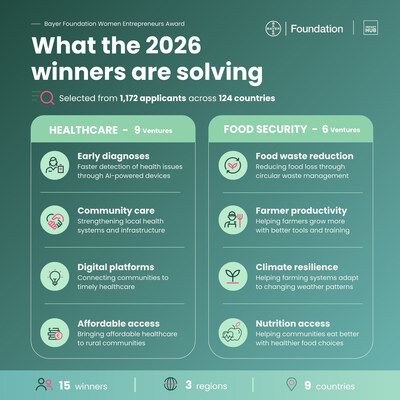
LEVERKUSEN, Germany and VIENNA, July 7, 2026 /PRNewswire/ -- The Bayer Foundation Women Entrepreneurs Award, powered by the Impact Hub Network, honours 15 women from Latin America, Africa, and Asia addressing critical challenges in global healthcare and food security.
Selected from 1,172 applicants across 124 countries, this year's winners are advancing innovations from digital health diagnostics and AI-powered health monitoring wearables to climate-resilient farming and circular food technologies— all designed for communities underserved by today's markets. The 15 winners represent Brazil, Colombia, Nigeria, Kenya, Tanzania, Morocco, Indonesia, India, and Bhutan. Learn more about 2026 winners here: bayerfoundation-wea.com/2026
"These 15 women are already building solutions for better healthcare and food systems. Our role is to accelerate their journey to scale — connecting them to the capital, networks, and support they need to grow their impact faster."
- Chitkala Kalidas, Executive Director, Bayer Foundation
What's next for the 2026 cohort
This year's programme equips each winner with a €25,000 cash prize and a six-month accelerator focused on investor readiness — strengthening business fundamentals, sharpening impact metrics, and preparing for high-stakes investor moments. The goal: fund innovators and open doors to enterprise growth and global impact.
The cost of leaving women out
Women entrepreneurs are building solutions the world needs. Yet in 2024, they received just 2.3% of global venture capital. In MENA, just 1.2% in 2021 while in Asia, 2.4% in 2024. Bayer Foundation's own research found gender-based barriers to be the applicants' single biggest obstacle.
The economic cost is staggering: a BCG report found that equal investment in male- and female-founded enterprises could lift global GDP by 3–6%, adding $2.5–5 trillion to the world economy.
What happens when women entrepreneurs get funded?
Since 2021, the Award has given women-led health and food-security enterprises non-dilutive funding, network access, and a structured pathway to investor readiness — delivered with the Impact Hub Network, whose 130+ locations worldwide scout locally-rooted entrepreneurial solutions and provide mentorship that capital alone can't buy.
The results from the 2024 and 2025 winner cohorts make the case: the 30 women funded reached 5.4 million people with better healthcare, sequestered 6.2 million tonnes of CO₂, and generated $8.2 million additional income into rural communities.
Those are the numbers that result when the right support reaches the right founders.
About Bayer Foundation
Bayer Foundation advances social innovation and science to achieve Health for All and Hunger for None. It supports impact entrepreneurs and scientists in health and food security, especially in low- and middle-income countries.
About Impact Hub Network
Impact Hub is a global network in 130+ locations, empowering 500,000+ Impact Makers to build inclusive and sustainable businesses for people and the planet.
Photo - https://mma.prnewswire.com/media/3004162/BFWEA_2026_Newswire_Image_7_July_2026.jpg
Logo - https://mma.prnewswire.com/media/3004163/Bayer_Foundation_Logo.jpg

Die Zahl der Demenzerkrankungen in Deutschland könnte bis 2060 deutlich ansteigen und das Versorgungssystem spürbar unter Druck setzen. Nach neuen Prognosen des Wissenschaftlichen Instituts der AOK (WIdO) dürfte die Zahl der Betroffenen bei weiter steigender Lebenserwartung von derzeit rund 1,3 Millionen auf bis zu 2,1 Millionen zunehmen. Grundlage der Berechnungen ist ein kleinräumiges Prognoseverfahren, das das Institut gemeinsam mit den Universitäten Trier, Rostock und Köln entwickelt hat.
Die Analyse reicht hinunter bis auf die Ebene von 400 Kreisen und kreisfreien Städten und macht deutliche regionale Unterschiede sichtbar. Bereits 2020 lag der Anteil der Demenzkranken zwischen 1,0 Prozent in Tübingen und 2,6 Prozent in der brandenburgischen Prignitz. Für das Jahr 2060 erwarten die Forscher eine Spanne von 1,7 Prozent Demenzkranken in München bis zu 6,2 Prozent im Landkreis Elbe-Elster in Brandenburg. Besonders betroffen sind damit vor allem ländliche Regionen im Osten, die überdurchschnittlich altern.
Parallel zur wachsenden Zahl von Demenzfällen schrumpft der Pool potenzieller Pflege- und Betreuungspersonen im Erwerbsalter. Laut Studie kamen im Jahr 2020 rechnerisch noch 38 Menschen im erwerbsfähigen Alter auf einen Demenzfall. Bis 2060 dürfte dieses Verhältnis auf 21 Erwerbspersonen pro Fall sinken. Damit würden deutlich mehr Erkrankte von einer deutlich kleineren Zahl potenziell Erwerbstätiger versorgt werden müssen – mit entsprechenden Konsequenzen für Pflegeinfrastruktur, Kommunen und Sozialversicherungen.
Die Autoren der Studie betonen zugleich, dass der prognostizierte Anstieg nicht zwangsläufig ist. Nach heutigem wissenschaftlichem Stand lassen sich Demenzrisiken durch Prävention spürbar senken. Eine konsequentere Behandlung von Bluthochdruck und Diabetes, der Verzicht auf Rauchen oder ein höheres Bildungsniveau könnten dazu beitragen, etwa die Hälfte der Neuerkrankungen zu vermeiden. In einem solchen Szenario würde sich die Zahl der Demenzfälle im Jahr 2060 nicht weiter erhöhen, sondern sich auf einem Niveau zwischen 1,3 und 1,5 Millionen stabilisieren. Die Spannbreite der Projektionen zeigt damit, wie stark der künftige Versorgungsdruck von heute eingeleiteten Präventionsstrategien abhängen dürfte.

 View original content: