TAIPEI, June 3, 2026 /PRNewswire/ -- From June 2 to 5, COMPUTEX 2026 in Taipei runs under the theme "AI Together." Longsys (301308.SZ) showcases its full-stack edge AI storage portfolio under "Edge AI Storage • Integrated Implementation," together with its high-end consumer storage brand Lexar, to optimize local LLM performance and accelerate AI ecosystem collaboration.
Global Launch: AIDIMM™ & AILPBGA™ for Edge AI Inference
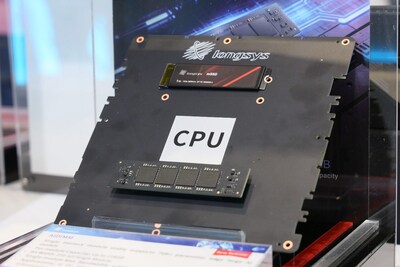
AIDIMM™ delivers up to 128GB capacity, 256-bit bus, and 307.2GB/s bandwidth in a compact form factor. It resolves memory, thermal, and upgrade pain points of AI agent hosts—a single module reliably and stably runs edge LLMs with over 70 billion parameters. Dynamic voltage scaling (0.9V–1.05V) and FDVFS power tuning enable high-performance, low-power mass deployment.
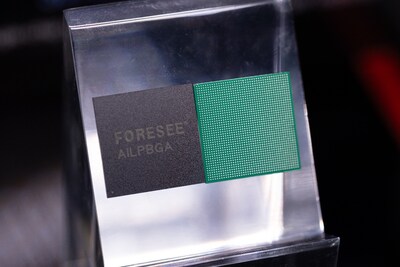
AILPBGA™ is a high-bandwidth chip for compact embedded AI inference. It offers 24–64GB capacity, 307GB/s bandwidth, native LPDDR compatibility, and a 22×22mm package. Compared to cloud AI high-bandwidth memory, it balances cost and power; versus LPDDR5x, it delivers multiple times the performance without SoC redesign, shortening development cycles and reducing costs.
Hardware-Software Storage Integration for Edge AI Compute-Storage Applications
SPU™ (Storage Processing Unit) + iSA™ (Intelligence Storage Agent) integrates HLCache™ to cut DRAM usage and hardware costs. The iSA™ scheduling engine uses expert offloading, intelligent cache management, and predictive prefetch to tackle MoE LLM challenges—improving local AI inference smoothness. Live demo on AMD Ryzen AI Max+ 395: 128GB DRAM runs a 397B LLM; 64GB runs 80B/122B LLMs smoothly.
HLCache™-enabled UFS boosts DRAM scheduling efficiency, allowing mobile terminals with lower-spec memory to run 13B/20B AI models. Live comparative demos confirm a smooth experience comparable to devices with much larger DRAM—optimizing BOM costs and extending device lifespan.
High-Speed mSSD Storage Media with Integrated Thermal Management for Storage Applications
Longsys displays Gen4/Gen5 mSSD using wafer‑level SiP. Gen5 mSSD delivers 11/10 GB/s sequential, 2.2M/1.8M IOPS, up to 8TB, with VC liquid cooling for sustained peak performance. Gen4 mSSD has achieved commercial deployment with major PC OEMs.
Global Expansion and Brand Power Drive Edge AI Adoption
Lexar debuts AI‑Grade Gen5 storage based on AI Storage Core, improving edge AI efficiency while reducing DRAM needs for AI PCs, smart imaging, and robotics. Celebrating its 30th anniversary and the upcoming FIFA World Cup, Lexar launches Argentina National Football Team co‑branded PSSD/USB drives. Founded in 1996, Lexar has global reach via Costco, Best Buy, and e‑commerce platforms, bringing edge AI storage solutions to worldwide creators and edge computing.
Looking ahead, Longsys will continue leveraging its full‑stack storage foundry capabilities to deliver practical, industry‑benchmarking edge AI storage solutions.
About Longsys
Founded in 1999, Longsys (301308.SZ) is a globally leading branded semiconductor memory enterprise, integrating R&D, design, packaging and testing, manufacturing, and sales services. For more information please visit https://www.longsys.com/, and follow Longsys on LinkedIn and Facebook.
Photo - https://mma.prnewswire.com/media/2994151/image1.jpg
Photo - https://mma.prnewswire.com/media/2994150/image2.jpg
 View original content:https://www.prnewswire.co.uk/news-releases/aidimm--ailpbga-make-global-debut--longsys-spotlights-full-stack-edge-ai-storage-at-computex-2026-302790059.html

Ein Zwischenfall mit einem Kleinflugzeug hat am Montagnachmittag den Flugbetrieb am Hamburger Flughafen vorübergehend zum Erliegen gebracht. Eine aus Cannes kommende Maschine setzte bei der Landung mit der Nase auf und wurde dabei beschädigt, wie ein Flughafensprecher mitteilte. Verletzt wurde niemand. Nach Angaben des Sprechers war das Flugzeug in Hamburg gelandet und „dabei zu Schaden gekommen“.
Dem Boulevardblatt „Bild“ zufolge verlor das Kleinflugzeug beim Aufsetzen sein Bugrad und setzte anschließend mit der Flugzeugnase auf der Piste auf. An Bord sollen zwei Personen gewesen sein. Offiziell bestätigt wurden zunächst der Schaden an der Maschine und das Ausbleiben von Verletzten. Um welche Art von Flug handelte, wurde zunächst nicht detailliert erläutert; laut „Bild“ soll es sich um eine Socata TBM-700C gehandelt haben.
Die Beschädigung der Maschine führte dazu, dass der komplette Flugbetrieb in Hamburg zeitweise gestoppt werden musste. Während der Bergung des Flugzeugs und der anschließenden Reinigung der Start- und Landebahn waren weder Starts noch Landungen möglich. „Das muss sehr gewissenhaft gereinigt werden“, sagte der Sprecher. Schon kleinste Trümmerteile könnten beim Starten und Landen gefährlich für andere Flugzeuge werden.
Die betroffene Maschine traf gegen 16 Uhr am Hamburger Flughafen ein. Spezialisten sollen nun untersuchen, wie es zu dem Vorfall kommen konnte. Der Flughafen nahm den Betrieb wieder auf, nachdem das Kleinflugzeug geborgen und die Bahn gereinigt worden war. Mit Verspätungen und Umleitungen war in der Folge zu rechnen, während sich der Verkehr schrittweise normalisierte.