SHANGHAI, May 29, 2026 /PRNewswire/ -- Trip.com Group, a leading global travel service provider, explored the future of the Attractions & Tours (A&T) sector at the Attractions & Tours Global Partners Forum, part of the Group's annual Envision.2026 conference.
Held at the prestigious Shanghai Concert Hall, the event brought together partners, including attraction providers and travel-sector KOLs, to examine how technological innovation, experience enhancement, and global collaboration are reshaping the fast-moving travel and attractions industry.
Driving Smarter Travel Experiences with AI
Mr Jim Ji, Vice President of Trip.com Group and CEO of Attractions & Tours, emphasised that advances in artificial intelligence (AI) are reshaping the competitive landscape of the attractions and tours industry. As travellers increasingly change the way they discover information, make decisions, and complete bookings, competition is shifting beyond traditional inventory and distribution advantages toward a broader focus on customer experience, operational efficiency, and global coordination.

In his keynote, "Boundless • Reshape • Synergy", Mr Jim Ji noted that "AI is not just a tool — it is a fundamental engine for creating a smarter, more personalised travel experience."
He further explained that AI is being used to help attraction providers better understand customer preferences and enable more accurate matching between products and users. By applying AI across product presentation, content discovery, service fulfilment, and experience delivery, the industry is evolving into a more intelligent model, better aligned with growing demand for diverse and personalised journeys. These shifts are already influencing traveller behaviour, with survey data showing that 29% of travellers have started using AI for itinerary planning and transportation.
Advancing Digitalisation Across the Sector
Mr Chase Liu, Vice President of Trip.com Group and General Manager of International Business for the Attractions & Tours, outlined four key strategies to unlock growth: expanding offerings, amplifying visibility, enhancing experiences, and connecting systems. He also observed that travellers' decisions are happening online more often, pointing out that "Being online is not optional. It's where everything happens."
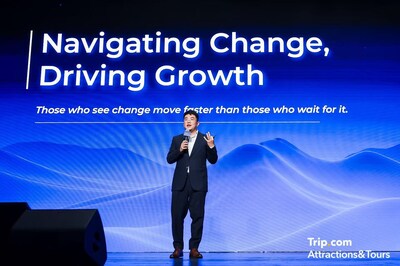
Reflecting this shift in traveller behaviour, the attractions sector has been undergoing a broader digital transformation, with operators increasingly adopting smarter ticketing and booking solutions to improve accessibility and operational efficiency.
Creating Deeper Travel Inspiration through Content
Alongside technological innovation, the forum also focused on the role of dynamic and engaging content in shaping travel decisions. This is especially important as the demand for experience-driven travel continues to grow, pointing to a broader shift in traveller preferences toward immersive and memorable activities.
To capitalise on this trend, Mr Dylan Dai, Vice President of the Global Trip Community, took to the stage to highlight the strategic synergy between Trip.com Group's content ecosystem and the Attractions & Tours business. He explained how community-driven content is being leveraged to guide users from initial inspiration straight through to transaction.
Through personalised content, Trip.com Group's platforms help travellers discover experiences that align with their interests, from cultural tours to culinary explorations. By integrating inspiration with seamless booking capabilities, these platforms not only drive higher conversion rates but also foster stronger customer loyalty.
Strengthening Global Partnerships
At the same time, Attractions & Tours reinforced its long-term global partnerships by signing MOUs with 11 overseas partners in Oceania, Europe, and Southeast Asia. Trip.com Group will continue to deepen collaboration with global partners to unlock new growth opportunities, building partnerships that go beyond transactions. Closer cooperation in areas including customer insights, product optimisation, technical support, service enhancement, and international marketing will help attractions gain broader visibility and reach wider audiences worldwide. Collectively, these initiatives highlight Trip.com Group's extensive global attractions network and its commitment to fostering collaborative growth across regions and destinations.

Photo - https://mma.prnewswire.com/media/2990586/1.jpg
Photo - https://mma.prnewswire.com/media/2990585/2.jpg
Logo - https://mma.prnewswire.com/media/2919909/Trip_com_Group_Logo.jpg
 View original content:https://www.prnewswire.co.uk/news-releases/ai-and-content-reshape-attractions--tours-at-tripcom-groups-global-partner-forum-302785572.html

Die von US-Präsident Donald Trump angekündigten Zölle von 25 Prozent auf Neuwagenimporte aus der Europäischen Union würden nach Einschätzung von Branchenexperten vor allem die deutsche Autoindustrie treffen. Berechnungen des Center Automotive Research (CAR) in Bochum zufolge kämen allein auf die Autoproduktion in Deutschland zusätzliche Belastungen von rund 2,5 Milliarden Euro pro Jahr zu. Hinzu kämen weitere Kosten für US-Exporte deutscher Hersteller aus Werken in anderen EU-Staaten.
Obwohl sich die Maßnahmen formal gegen die gesamte EU richten, sieht CAR-Direktor Ferdinand Dudenhöffer insbesondere Deutschland im Visier Washingtons. Die Exporte anderer ausländischer Autobauer in die USA seien „unwesentlich“, sagte er und sprach mit Blick auf die neuen Zoll-Drohungen vom möglichen Beginn eines „Wirtschaftskriegs gegen Deutschland“. Die Maßnahmen würden die Hersteller jedoch unterschiedlich hart treffen, abhängig von ihrer Produktionsstruktur und Präsenz in den Vereinigten Staaten.
Relativ besser gestellt wären demnach Konzerne wie BMW und Mercedes-Benz, die über umfangreiche Produktionskapazitäten in den USA verfügen. In ihren US-Werken fertigen sie vor allem SUV-Modelle, die den Großteil ihrer Verkäufe auf dem US-Markt ausmachen. Diese lokale Produktion wirkt nach Einschätzung Dudenhöffers wie ein „Zollschutz“, weil in den USA montierte Fahrzeuge nicht unter die geplanten Importzölle auf Neuwagen aus der EU fallen würden.
Deutlich verwundbarer wären dagegen Marken wie Audi und Porsche, die ihre Fahrzeuge bislang weitgehend aus Europa in die USA liefern. Für sie könnten die neuen Einfuhrabgaben ein Anreiz sein, Pläne zum Aufbau eigener Produktionsstätten in den Vereinigten Staaten zu beschleunigen. Vollständig auffangen können die Hersteller die zusätzlichen Kosten nach Einschätzung des CAR-Instituts jedoch nicht. Ein Teil der Belastungen dürfte über Preiserhöhungen an die US-Käufer weitergegeben werden. Dank der starken Markenbindung rechnet Dudenhöffer zwar nicht mit einem abrupten Nachfrageeinbruch, die deutschen Autobauer stünden jedoch vor der Herausforderung, ihre Preissetzung und Standortstrategie zügig an die neue handelspolitische Lage anzupassen.